 Apple Podcasts
 Spotify
 Castro
 RSS Feed
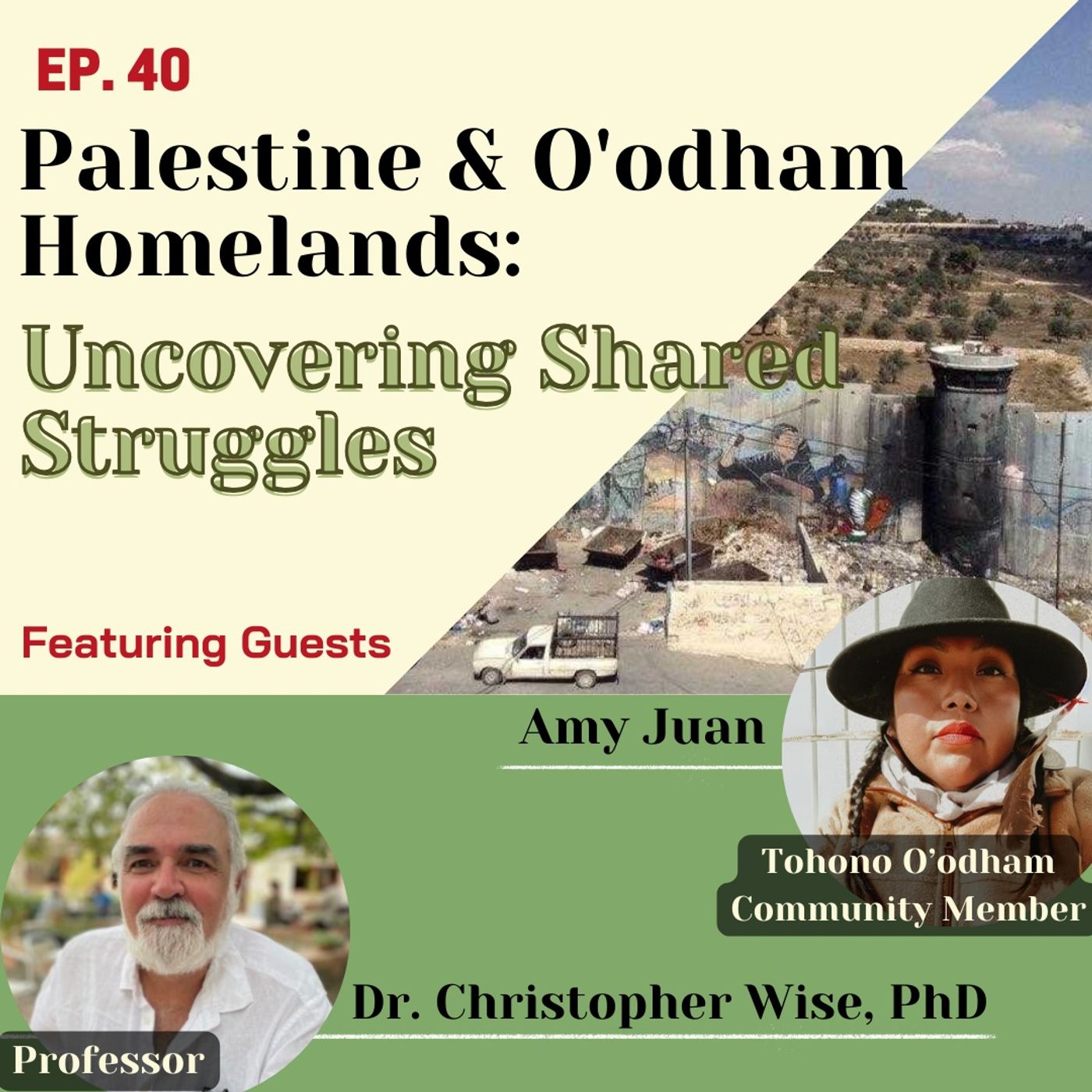
In this thought-provoking episode, join us as we dive deep into the intersecting worlds of Indigenous issues and the Palestinian-Israeli conflict. Tina Andrew, Executive Producer, and co-host Napoleon Marrietta lead a dynamic discussion, bringing...


In this thought-provoking episode, join us as we dive deep into the intersecting worlds of Indigenous issues and the Palestinian-Israeli conflict. Tina Andrew, Executive Producer, and co-host Napoleon Marrietta lead a dynamic discussion, bringing together a diverse panel of experts. Dr. Christopher Wise, a seasoned professor with a wealth of experience in Africa and the Middle East, adds academic depth to our conversation. Another special guest Amy Juan, drawing from her firsthand experiences in Palestine-Israel, offers a unique perspective that uncovers striking parallels between the O'odham and Palestinian lifestyles and experiences living within' a militarized environment.
Throughout the episode, our conversation centers on key themes such as colonization, land rights, and cultural preservation, spotlighting the universal nature of these struggles. The parallels between the experiences of Indigenous people and Palestinians serve as a lens to examine complex global issues. We emphasize the importance of understanding historical and cultural contexts as we explore the intricate web of the Israeli-Palestinian conflict.
This dialogue challenges listeners to think critically about these issues beyond mainstream narratives, inviting them to explore deeper dimensions of historical, political, and social significance. Ultimately, this episode offers a multifaceted exploration of global conflicts, Indigenous issues, and the profound impact of personal narratives on our collective understanding of complex social and political dynamics.
Tune in for an enlightening and engaging conversation that aims to broaden your perspective on these pressing global issues.
Background music: Dusty Decks "Top Glare", Ahmad Kaabour "Ounadikom", Hannes "Summer 3000"
Recorded: November 22, 2023
0:00 For full disclosure. The views and opinions expressed in this podcast are those of the guests in the host. The content here is for informational purposes only. It's good Thosh, everyone. This is Tina here with you on another episode with a special guest, doctor Christopher Wise, who outlet introduce himself here in a few But we've also got co host Napoleon here with me today to help join in on this very interesting and important conversation with everything that has been happening in the world. We'll get a little bit more into that as we dive deep into the conversation, but first I thank you Dr Wise for coming on board and being part of this interview with us. My name is Tina Andrew.
1:15 I'm the executive producer of the Atom Young Voices, and I would like Napoleon to go ahead and introduce himself and then we'll get into your introduction doctor. Why so, Napoleon, if you want to introduce yourself to our guest here th Gosh. My name is Napoleon Marietta. I'm from the Heal River Indian community. I'm a graduate student here at Arizona speak University, insuing doctor my masters in American Indian studies, but they have physics, some indigenous rights and social justice last semester, hopefully going to graduate this semester with the second Masters in Poco administration. So really happy to be a part of the conversations.
1:56 But yeah, thank you so much for joining us. Doctor wise, thank you, yes, and doctor wise, if you could introduce yourself to the listeners a little bit of your background, who you are, where your homelands are, and where you currently are now, okay, thank you very much. Well, I'm a professor at Western Washington University, where I've taught since nineteen ninety six, and so I've I've been in Washington for for a long time. But I am originally from Oklahoma, and I was born in Oklahoma, and my family comes from well, from both sides of the state. Actually, my mother's family is from Omolgi area and there at Muscogee.
2:38 My father's family was from Enid, from the other side of the state, from Enid and Clinton. I am somebody who has spent a lot of time translating various writers from Africa in the Middle East. I've lived in Jordan, taught for almost two years at the University of Jordan, and i'man and I taught at the University of Brita Fosso and Wagadu or University of Wuagadoa Fosso, and these were formative experiences for me as a young professor. I've spent a number of years teaching the literature of Africa and the Middle East and tad studying it. Every winter. I took fifteen students from Western Washington University to Senegal on a Senegal program where we study the culture of Senegal. And so I've also spent a lot of time, you know, teaching and studying writing about the cultures of West Africa and what's called the Sahel zone of the continent.
3:39 Wow, that's very interesting. Well, thank you so much for taking the time to be here with us to talk about the specifics. Maybe we can talk a little bit and you can talk how that experience went with your talk at the University of Arizona. And it was recently in the beginning of November that you I see here that you did do a talk Law of Return versus writ of Return, Israel, Palestine and poetry from the inside. And then we'll get into a little bit more of what you had wanted to focus on. But I just wanted to give the listeners a little bit more context of how we got in touch and what we felt was important for us to share on the podcast with the listeners. But if you can share about that recent talk that you did, all right, So the talk that I gave was on you know, I think as someone who has you know, I lived, like I said, I lived in Jordan for a couple of years, and most of my students were Palestinian, and I've spent many years, you know, studying this conflict and teaching about it as well. And one of the things that I consistently see is that Americans, they in general, you know, they're concerned about what they see over there, but they don't have they just don't have a framework to understand what's happening. Because the region is so complex, and it is complex and the history is explordinarily complex. But
5:12 there are certain basic questions that one can focus on to begin to understand the differences in terms of what's happening there on the ground. And so in this particular taught, we read the poetry of a Palestinian poet named Mamoud Darvish, and then we read the poetry of an Israeli poet named Yehua Amakite, and we compare in the talk they were being compared on the differences to shed light on the differences between what's called the law of return and what is the right of return. And the right of return is what is consistently asserted by and has been by the Palestinians since since the beginning of the occupation of the very sort of knock busts that have occurred historically. And the law of return is the law in Israel that enables Jewish people from all over the world to migrate Israel, you know, not on the basis of their residency, but on the basis of their However, everyone wants to articulate Jewish identity as either a spiritual belief or as a matter of one's blood ancestry is one half, for instance, a maternal genealogical lineage that can establish one as being Jewish. And so the Palestinian claim has always resided on the right to know what Kant calls cosmopolitan right, which is the the right for all of us to occupy the
6:46 surface of the earth together and to share the earth together. And that becomes then the basis of you and law and what cont calls you know, the universal human right of hospitality, that we all have the to be welcomed, and we all have the right Article thirteen of view in we all have the right to return, you know, if we leave our country to return back to our country. If we leave our country, we can't be kept out of where we left from. That's part of our cosmopolitan right. And this is the right that the Palestinians are serving. And you know, I think it's a lot of times poetry can reveal a great deal about these questions when you can kind of get into the mindset of some of the most important minds that are was it like a famous poet, Shelley said, Poets are the unacknowledged legislatures of the world, and so it's a it's one way to begin understanding different sins and how people are approaching this conflict. Thank you so much for that intro to your talk recently, And yes, you're right with this entire conflict that is currently happening. A lot of things are happening, and I thought it would be good for Napoleon to also join the conversation because he has also seen as a student on campus right now. He's seen various things
8:20 happening and as well as here at in Tucson, at the University of Arizona, they've just recently, I know students are pretty upset about two professors who have been put on leave because of their conversations that they've had in the classrooms regarding Israel and Palestine. But Napoleon, did you have want to ask a question or have something to add or just share how things have been going at Arizona State University in regards to the topic. Yeah, thank you for were for sharing that with me. So I've been taking this class with transporder Studies and we've talked about a various different areas or various different topics are surrounding border lands. And recently we finished up our class and the name of the classes Indigenous Nations and human Rights on the Border. And we've been reading different kinds of work by people of color, Mexicans and indigenous writers, talking about a lot of the kind of struggles that we see in the complexity of the US Mexican border and how those are relations are very global. And the last reading that we did was held on settled Orders by Felicity and Maya Schaeffer, And
9:54 at the end of the chapter she did mention that this similar plight of indigenous peoples that are across the border as similar to the Palestinian the struggle that we see going on and a lot of the similarities and complexities that have happened over the years. And I think what you're mentioning is that it was totally good because I think, like in our conversation that we had in our class, was trying to figure out and analyze, well are they similar who are the Palestinians and who are you know, Hispanics from Mexicans that are along the border here. So we're talking about surveillance and how those are utilized here the US Mexico border. What are some ways that indigenous people can understand this complexity of like what you're mentioning, like Americans can't really grasp the concepts of what's happening because this is over hundreds and hundreds of years of occupation and also fire as well, And I think that really is similarity, that that similarity and difference is Like one of the things that we mentioned is like you know, as all of them, you know, living around the border, those are very different from you know, what we would say is, you know, Palestinians, but there is a lot of similarities with the way colonialism and stellar colonialism has impacted all them is going to be very different. And I think it was a really good conversation in that sense and the way you sort of brought
11:28 it to like, yeah, these concepts and it's always the same question as like how do we help are how can we support you know, indigenous you know, sovereignty and the complexity of American concepts really don't fit in those narratives that we see along the border. And then what you're mentioning with poetry and art and that sort of resistance too. So I think a lot that was a really good point that that draw me in is ways that we constant, the ways that we see our concepts are different asians that you see the militarization of each from I guess globally Team Zone. I just wanted, yeah, thank you very much, so very very thought provoking comments. I let me let me say this. I think that if we look at the history of let me put this in contact. When I first came to Jordan to teach at the University of Jordan, it was a week after nine to eleven, and I left Jordan, like I think, like it was a week before the United States invaded Baghdad, And so I was living there in that very sort of volatile time, and for personal reasons, I couldn't I just in terms that we didn't know what was going to be happening from day to day, and so one becomes all obsessed with the with with the daily events.
12:54 And and so since that time, I've been following what's been going on in the region, and and and I've tried to think about it in terms of how it is similar to what's been going on in the United States. I've even written about this in the past that following the comments of you know, Yasir Arafat, who who liked to call the Palace, he called the Palestinians on occasion, the Red Indians of the Middle East. And he always he always insisted that the situation of the Palestinians was more akin This is again Arafat, the founder you know, of the PLO, was more akin to the situation of indigenous people in the United States than it was to say, African American people in the United States are people who came from the Transatlantic slave trade.
13:50 And that's because he believed, as do many Palestinians, that the that what has happened happening in Palestine, you know, since the formation of the State of Israel is not a matter of a return from a two thousand year exile, but is a matter of settler colonialism emanating from Europe. Because most of the people you know, who colonized or who came, let's say, during the early days of the Zionist movement, were of European origin. And I think it's important, you know, to remember that there was indeed a very significant Jewish population that was a nischrom or Arab Jewish people who were in fact invited at a certain point to join the Pan African movement, to join in with the with the various Arab states that were seeking in the period of decolonization to establish you know, a strong independent Arab world and all of that.
14:48 Really, what we're seeing in goz Of for instance, today is a continuation of that. One of the ways in which I think we can begin to understand what, let's say, for instance, today Palestinian people are going through is by looking at one's own history and seeing similar experiences of dispossession and similar experiences of having undergone our colonialism. And so I could just use one example here, maybe two examples. But the first is I do a lot of translation, and recently I translated the work of a tour Egg poet named how It. And so since a lot of my research is focused in West Africa, the Touregg you're not familiar with this history because of the US foreign policy. When President Obama, under the under the urging of Secretary of State that I'm Hillary Clinton, decided to invade Libya and depose Kadaffi. This caused the entire region to become destabilized, and so essentially what happened in Iraq under George W. Bush also then began to happen now in Africa during the Obama on a period. This caused Northern Mali to fragment and become an independent state.
16:06 The state that was declared was called Aswad, and it was envisioned by some as an independent tour state. And the poet that franslated was Toger nomadic Berber people. They're not black, they're not Arab, but they're people who live in the desert Sahara desert they tend to write camels, and they trade and salt, the very traditional people. And as a wad was after twenty and twelve when the French invaded Mali to drive out this rebellion, and some of them, good portion of most of them at the end were Islamists. But it caused those whould long for an independent tourag nation, the Tory people to go through a very terrible death march across the desert most into Marta.
16:49 And I begin to watch footage of this terrible death march of these people, and you know, as someone who came from the history in which you know the Muscogee who were transferred forcibly under the you know, the sort of lunatic years of Andrew Jackson to come to from Alabama and Georgia into Oklahoma, I couldn't help but reflect upon these these parallels, and so I began this poet and Howard he wrote and basically an epic poem about the death march of the Torigue when they were expelled from from gal and from Timbuktu and into the desert and where it destroyed people completely, and it was it was a heart wrenching poem to translate, but but it also had I think this is really important.
17:41 This is one of the reasons why I am I teach poetry is you begin to understand that there can be no strong nation with that it's poets. And Howard is one of those poets. I think, you know, for the Muscogee, for instance, I think it's someone like joy Parjo who is who is an inspiration and nations need people to inspire them. And at the end of this very tragic poem, the poet inspires the people who are defeated and destroyed to rise up and to experience a kind of a rebirth. That is what the poet does is gives breath or spirit to the people. And so I think poetry is something that should not be neglected. And so as I've been getting, you know, responding to friends of mine from the Middle East, from Jordan, and say we'll say something, do something, get involved in this, you know, and help us because of what's happening in God, which is fantasized, the killing of the children is unspeakable. But I do think that poetry has a place in this conversation. And so that's what I've been seeking to do, is to bring poetry to the forefront, so to remind us all of our humanity in a time of the most endeous crimes against humanity that are now being committed. Yeah, as a person, as an individual who is not familiar with and does not have that kind of history or knowledge of the history of the lands there, the history between Palestine
19:14 and Israel, I'm just learning as all the things are unfolding and seeing everything you know in the media, but also in social media. You know, with the podcast, we have a lot of followers who you know, speak up and support and share their thoughts about their feelings of what's all happening between Palestine and Israel, and a lot of our listeners are well, actually our followers on social media are in support of Palestine and you know, in support of demanding sees fire with this whole situation. But before we get even more further into that conversation, I also know that you you wanted to also focus in the conversation of US foreign policy in the Middle East from nine to eleven to Gaza. Well, yeah, I think that's that's a really important piece of the puzzle. Look, let me just say one last thing, however, about the previous question that that Napoleon asked if I could just do one quick follow up on that. That that occurred to me is that I think by learning the by by seeing these that people have experienced parallel forms of suffering and oppression through, you know, colonialism, that we can better empathize and understand what's going on there because there's a history here too. So if you
20:48 think, for instance, of the Muscogee, who were you know, who underwent ethnic cleansing, transfer, you know, whatever term you want to use, but he marched on that long trail of tea years from Georgia and Alabama to Oklahoma to the eastern part of the state and Magi, which is which is if you go to the courthouse and Mogall, see there's a sign out there that says this is where the Trail of Tears ended. And so they went through that. But then they went through a second period of despoilation, during the period of the allotments, during when people were required to sign the dodge roll, and the land which had formerly been owned collectively was then divided into many allotments so that it could more easily be stolen. Essentially, so, for instance, in the case of my own grandmother she had, she got a child's allotment, so she had an eighty acre allotment near the border of Oklahoma and Arkansas. But like many others who were given a lotments, she was not able to hold onto that because then squatters came in and drifters and so on. So if you look what we all know that the Supreme Court recently we affirmed Muscogee sovereignty. If you look at that history of you, like they said, well it's Muscogee, the Supreme Court debated, is Muscogee's, you know, still a nation given the way the way in which you know, like you people that still held on to their allotments to their land, but then living among them were the squatters and the ancestors of squatters
22:18 and so on. And the Supreme Court ruled obviously that the Muscoge was indeed a sovereign nation because it had never been dissolved by an Act of Congress. But that history, too is a way that one can begin to understand what is going on in the West Bank, which is again the people that are Palestinians are experiencing set of their colonialism and legal forms of theft. You know that that are being enabled by by Israel and then and people there now live among each other much, you know, in the same way that happened in muscoge Nation and other places. So it's that experience of having undergone that kind of invasive set their colonialism. For the Muscogi, I think is also if you're a Mascogy, it's one way you can you know, or Cherokee or you know, other tribes that underwitness a lotment system that you can look at what's going on in Palestine and say, oh, well, that's that's what's happening, that that's what they're doing. They are legally stealing the land, and they have debased Palistinian sovereignty to the point that it's essentially non existent.
23:30 So for instance, the reason why you had Hamas in Gaza was, you know, Hamas is a hobby Islamist, you know, militant organization. So they're very influenced by the kind of Islams or the nineteenth Centuryhabism that emanates out of Saudi Arabia, which is a very let's say, fundamentalist, simplistic interpretation of the Koran, and which is to say, I don't mean that necessarily pejorative we just descriptive that the Wahabbi doctrine is very focused on much like the Protestant tradition. The prostant tradition wanted to get back to Apostolic the church in the Apostolic period the first one hundred years after the time of Jesus. The Wahabby want to sort of go back to what they believed for the glory days of the prophet Muhammad fourteen hundred years ago. But the Palestinian of forty originally the Palestine or poo fat that they were secular Pan Arab nationalists. And this is what the part about foreign policy enters in the play is because it's been US policy from the very beginning targeted the Pan Arab movement, so or let's say Baptism, which and all Baptism really was and its inception was an attempt to a sort of Arab identity politics movement, not unlike you know, Pan Indian movements in the United States. Pan nave to get different peoples together and
25:00 to not focus on their religious differences. So it didn't for the Baptist friends since that you you know, it didn't matter if you were suing Si Christian, drus Adelite or even you know, Jewish. What was important was that you had the swift shared ethnic identity, and so, you know, the Baptist movement was a kind of an Arab nationalism just like Zionism was. It was a Jewish nationalism, but it was the United And so what we're seeing in Gaza is sort of one of the last stages of this is that the US foreign policy has systematically targeted this the you know, secular nationalism. The only nation left really is Syria, where you have you still have a Baptist you know president there in the Saut family is still sort of the last remnants of that. But Hammas. The reason why, so basically, you know, fifteen sixteen years ago, the reason why I'm Hamas, which is an Islamist group from Saudi that had the swift similar doctrines of those in Saudi Arabia, rose to power was because the Palestinian authority had been so co opted by Israel that the secular nationalists like which you know, Airfat fata Plo, that they were so discredited that people voted for this other group. But they put it in context, it was like they were a tribal The Palestinian authority became like a similar to what you had say and wounded me and Rosebud and so on. Prior to the rise of the Aim movement in the early seventies, as you had a police force that were ostensibly part of the tribe that were
26:37 in fact leasing the interests of external agents, in this case the Israelis, and so people just lost faith in the secular in Fata, in the poo, they turned to Amas, and then the United States and Israel decided to punish the Gosins for their support of MS and they encircled it. They started about sixteen years go. And then and then it's you can't imagine how horrible the conditions in Gaza, not just at the start of this conflict, but for fifteen sixteen years, the deterioration of people's lives and mental health, and it's just been horrible. Here in the United States, people say, well, you know this, this event. Why did this event begin on October the seventh, Well it didn't. Two years ago, for instance, I was asked to write an article for a journal called Arena about about gods of what was going on in Gaza, because at that time the Israelis had just killed like two thousand, five hundred, two thousand, six hundred people in Gaza and Gaza and the Hamas had killed I think thirty five or maybe it's one hundred and thirty. It is something of that neighborhood of Israelis. So it's you know, the conflict has been going on for a very long time.
27:59 It's not a didn't start just on October seventh. Thank you for sharing that the complexities of it, you know, I haven't just by reading and everything learning about some of the similarities that were here focusing on in the US occupation. And so I think what you mentioned before about the ways that people are sort of finding that breath of I guess you would say form of resistance or understanding with it, with you know, poetry and things of that nature that really bring back a lot of the ways that we conceptualize occupation. And I think what you mentioned, like the stories, the history, the oral history, the writings of people who live in these territories, and I think that's really a really good way to size you know, with our podcasts, you know, we use this form of media to really bring it to others who want to understand these stories are different areas and especially with this because you know, there's always so much complexity when it comes to the US and in Mexico and as far as the all information, because you have essentially three entities and you can't we can't just you know, focus on you know, one
29:32 or the other. There's like three forms of you know, levels and of occupation and what we seen, and so I think when you're talking about poetry and the ways that we breathe this information, and it's really powerful because I think for those folks out there who feel vulnerable in these cases when we were seeing things happen globally and when you're mentioning, well, to study ones on history to really unravel a lot of that is very powerful. And whether that's poetry, podcasting, any sort of speaking your own language, I think those really give folk to a lot of Indigenous people because we can relate to these oral stories, these things that we're told by our grandparents, and then legally when we look at what you're mentioning, what happened in the Spogia and then here the close occupation of being removed by the Goddison purchase, and a lot of these things that were happening outside of our hands. So I think those are very powerful ways of the people really speaking to their own histories because it can be complex and it's a lot of overwhelming stuff. You know, we're seeing dead, we're seeming continuous, you know how that's putting on different forms of media. The word it really comes into is just you know, poetry and things that we're you know, your knowledge of sharing with us right now, and and how we're to the farm as a podcast when you tell the narratives. So I just want to thank you for sharing that because it made
31:06 me think about a lot of my own kind of understanding of the of what's going on, but also like reflecting on it and then like finding ways that we can you know, I guess, sort of get through it, you know, because you know, there's a lot of things that are that are really heartbreaking, but then there's that triumph of like what you're mentioning, this triumph of the triumph of stories. Yeah, so I think that was really important and thank you for sharing. Yes, I feel that very strongly. The whole idea of the think of inspiration, spirit, inspiration, breath with the pup pullet is you know, we need that spirit and inspiration to keep us to keep us alive. In fact, there can be no strong nation without it, without it, poets without But I mean that. I don't mean that just in terms of someone who sits down and writes a poet and presents it at an academic event. I mean people who give breath or spirit to to to the people so that they can, you know, envision a better future, a different future, even in the most dire of circumstances.
32:22 And for instance, the case of Victoric people who I was telling you about, it's their their suffering is continuing, it's it's it goes on to this day and their situation gets worse and worse. And I think it's important too that we remember in this connection that we the whole world right now is focused on Gaza, and what has happening in Gaza is indeed unspeakable. But I think it's also important to remember that that there are people's suffering and many other places besides Gaza. The Northern Mali is just one of them. What's happening recently in the Sudan and Ethiopia, what's been going on in Urkina Faso, in Niger and and and these these tragedies that are unfolding every day before our eyes, receive no no attention from us at all. And yet you know, again, if we think of this question structurally, we can see that that there are parallels that in effect, I mean, for instance, if you are you know, here in the United States and say, well, what's going on over there is what happened here, and what in a lot of ways is still is still happening. And I think, well, the reason why I had suggested that we also focus on the question for US foreign
33:57 policies because I think one thing that can be very helpful you haven't really spent a lot of time thinking about this, is to reflect upon, you know, what really underwrits, what is the ideology the beliefs that really underwright the exercise of foreign policy by our political leaders. And I think I wanted to mention this the example of Obama and Libya, because there's a kind of a perception that in the United States that we've got politicians Democrats on the left, Republicans on the right, and and and it's true that there are significant differences between them, but most of the differences between them reflect their you know, domestic their views about domestic politics in terms of international politics. We can see a line of continuity since particularly since World War Two, that in the Cold War, that runs to the present that all of our political leaders have been so called political realists, and the fear of UIs foreign policy. And this bid and going over and giving net and yab through a big hug before he got ready to invade Gaza and which now sort of we're up to almost fifteen thousand people and then killed they are half of whom are children. And you say, well, how how can this be? How can our leaders accept that that is a price it is acceptable to pay. So I was, I was reflecting on this, and I think, again, this is a
35:28 question where poetry can be very powerful. I was reading a poem by Yehuda Amaki, who's an Israeli poet, about and it focuses on a little boy, a father looking for his boy who's lost on Mount Zion, and then you have an Arab shepherd who loses his goat, and it's a kind of a failed allusion to while not so well, it's pretty overt to the Abraham to you know, to what is now at at Alexa and the alex at Mosque, which is the dome of the rock, the rock where Abraham was to sacrifice his son. In the Islamic tradition, that son is Ishmael. In the Jewish and Christian tradition it's Isaac. But the story is the same as Abraham was getting ready to sacrifice his son, and this is what the poem was finally reflecting on. But then God stayed the hand of Abraham, and a goat or ram appeared in the thicket, and it was sacrificed in the place of the son. If you look at the literature of the ancient Greek world, there's very similar stories that mark the end of and fantaside the end of the period when people often did sacrifice their own children. In the case of let's say the Greeks, the whole Trojan War cannot begin until Agamemnon places his daughter if Phigenia on an altar and commits an act of human sacrifice in order to get winds to shift so that they can then go and invade
37:02 Troy. And and there are you know, similar stories about how a deer appeared at the last moment was killed instead of if Virginia. I think I think the Agamemnon example of those particularly relevant because what it what it really illustrates, is it even from the ancient, from very ancient times, that culture, the cultures in the area have been willing to sacrifice their own children. And this is what infanticide is all about. The assumption that it is acceptable that a certain amount of children, your own children included, will die because of the necessity of warfare, that it is a sad but regrettable, even but unavoidable fact. And so cultures of war except that infanticide is going to happen. And certainly this is what we could say about the Biden administration in Gaza. And so I think we have to ask ourselves, when are we going to be ready to stop sacrificing our children? When are the people of the region. If they're looking to the example of Abraham, it's an example of the infanticide should not be practiced at all. It was supposed to commemorate or mark the passing of that practice. But clearly the people of the region have not. Whichever side of this conflict, John have not, you know, they accept the reality of infanticide, and maybe they shouldn't. Thank you
38:37 so much. Doctor. Wise, we have Amy who has been able to join us now. Thank you so much, Amy for coming on. I wouldn't want to keep you too long. I know you are traveling today, but if you could share with the listeners of an introduction of who you are a little bit of your background, and then we can go from there ascociatch everybody. Good morning. My name is Amy One. I come from then O the Nation, and I come from the Stuka district, but i also come from the communities of Artijrikshan and Whichijotek here in southern Arizona, thron out the Nation. And I'm here today to share my experience about traveling to Palestine Israel in twenty seventeen, and so I'm happy to answer any questions and share my experience. It is something that changed my life in a lot of different ways, and you know has come to a head today. So thank you for having me. And I'm really the words that doctor Whites ended with is you know, when are we gonna stop sacrificing our children? And that's I think that's the That's something that's really really resonated with me. Since since the conflict has gotten a lot more violent and has become more more people are becoming
40:14 more aware of the of the conflict and what's happening with genocide today. So thank you, I'm I'm ready. All right. We've kind of already just talked about various information in regards to a little bit more of the historical art of the areas. Doctor Whites has shared different examples of, you know, the similarities and the familiilarity that we experience as native people here in the US, and I know you've expressed and talked about that on your social media platforms. When all this started, you came on and you shared your thoughts, uh and talked about your experiences in Palestine and also talked about the similarities and just the things that you thought you knew but completely changed you visited the area.
41:09 Can you go ahead and share with the listeners of what that experience was like, what you learned from it, what you took away from that. Yes, so, I guess just also to give a little background one of the communities that I mentioned that I'm from, what you enjoyed. The Gordon Newfields is where my dad's family comes from and which you joined. The Gourd Newfields is right on the border of US and Mexico. And so I'm thirty seven. I grew up in the era of watching things change where we come from from the Donat nation, especially in the border area. When I was growing up and being with my family, especially my grandpa who was a rancher.
41:52 You know, we'd always be in the area. And you know, there wasn't a what we see now, which is we don't There wasn't a whole lot of border patrol. There wasn't any border patrol. Growing up. The border was a barbedier fence. You know, the crossing for us was a cattle guard. And so just over the years, watching the issues that we deal with as far as immigration, drug trade, and militarization of the nation, watching checkpoints come up, watching the border area change, watching surveillance technology go up, there's been a lot of concerns, I think, especially for our generation, who you know, us in our mid to late thirties, Like we realize by now that we're the last generation to really experience a lot of freedoms that our people have always had. But also those big changes like I was talking about, you know, having to go through a checkpoint every time we leave the res or the reservation or the nation in any direction.
42:55 But I think especially for communities that live along the border net we see a lot more activity as far as border patrol, and right now there's a lot of construction that's happening along the border area as far as roads and things like that. But the main project down there is the IFTS, the integrated fixed towers, which are a surveillance system that is built and comes out of you know, Albit Systems, which is in our Israeli company. And so there were connections that we had already made before I made this trip to Palestine in twenty seventeen, and I had the opportunity to go with the delegation called World Without Walls, because up until that point we had been doing work out here in the nation and surrounding communities, bringing awareness to militarization, how to deal with border patrol when we're going through checkpoints, you know, what are our rights. But also with the towers, any of the towers were coming at that time, we uh myself and you and other students and community members.
44:10 At the time, we're really trying to raise awareness going to our meetings, you know, asking questions of legislative council and our leadership about the impacts that these towers were going to have. And so because of that work, had the opportunity to go with the World Without Laws Delegation, which was made up of people from the US and Mexico, to go to Palestine and to meet with the people there. And so I tell people that in this trip, you know, and just listening to doctor Wise, you know, that's a lot of history, a lot of information about you know, the stories and the things that happened there that you know a lot of people are aware of a lot of all like them or Catholic. So we grow up, you know, hearing stories about these places. But actually, you know, I don't think there's a whole lot of autumn that have actually made it out there to see, you know, what it's really like. And so I tell people that when I went, I went with autumn eyes and I and I say that because, you know, once people found out that I was going on the trip, there were people who recommended books and movies and different things to watch before I went, But I really I didn't do that.
45:35 I just you know, prepared myself for making the trip. It was my first trip overseas and really just wanted to see for myself what the experience was going to be like. And so we were there for ten days, and within the ten days we visited a lot of Palestinian communities, families, refugee camps, villages, all all the way around, from visiting people in the Old City in Jerusalem, going out to the date farms out in the lower lands, going to Jericho and really seeing the landscape and really meeting with the people and hearing what they were going through. So, you know, there were so many stories and I can I think I can talk for days about what that experience was like, but really what I what I want to share is, yes, there were so many connections between what's happening here and with in the US, with native peoples, but also with with aut Them And that was one of the things that I was surprised about was that the communities that we met with were already kind of familiar with with aut them or native people of their native history, because it's so similar. And that was a surprise, but I guess it shouldn't have been a surprise, you know,
47:06 because of what we're facing. And so the militarization especially was I guess something that was really surprising to me. And this was just again with my autumn eyes, and like what I grew up hearing, you know, you hear about the Holy Lands, and you hear about you know, this this place that it's supposed to be. But when I was there and I saw a lot of what we're what we're seeing today that has escalated a lot of the separation, the harassment, the racism, the genocide, but mostly the militarization, I guess was what I was really surprised to see. But it was also very familiar with the surveillance technology everywhere. Going through the checkpoints was another one. I have these cards that given to us to be able to move around through the different areas and their State of Israel border control permits that we were given to be able to even move around, and there's two of them, a pink one and the blue one. Depending on the color, you know, is what controlled your ability to move from place to place. And when we would go through these checkpoints, they were very similar to what we see here. You know, you start, there's dogs, there's guns, there's cameras, the questions about where you're going, what you're doing, all
48:39 of that, who you are, where you're coming from. Uh, that was the same and for myself and another odd woman who went Nellie Joe David. You know, we were kind of, for lack of a better words, tripping now because it was so similar, and a lot of the people in our delegation had never had that kind of experience, so it was scary for them, and of course it was you know, it made us nervous, but at the same time it was bittersweet because we had already learned how to deal with those types of situations and that's how similar it was. Also to see the erasure, the removal of Palestinian families and communities and to see it with their own eyes. You know, you would see housing projects or just building projects that were ready to go up, but as soon as they're almost done, they're not down by the Israeli Army. Also bedding communities, which are the herding communities that are out there on the land, herding sheep, goats, you know, cattle, the herding lifestyle, but also being forced to move away from these places that they've historically always done that I had that lifestyle, or you know, being kept from being in certain places.
50:06 Also, water issues were another thing that we saw, just the resources in general. You know, a whole community could be wiped out and replanted with vegetation and looked like there was never even a community there in the first place. And again seeing how similar the landscape was from home. You know, you could go from the ocean to the desert, to the forests to the canyons and in a matter of you know, hours just driving around. And then also the culture, you know, the separation of men and women, which a lot of people, I think, especially in Western culture, uh, can be uncomfortable with and see that as a bad thing. But that was also something really similar, uh, that we see in our communities, you know, especially when we're hosting feasts or what have you. There's definitely those women's roles and men's roles, but it's not you know, out of disrespect. It's actually out of respect to giving giving each other our spaces are, especially in social circles and food, you know, if people are familiar with gemis or tortillas, that was also something really similar. And so it was a whole mix of different experiences. And I think for myself as an indigenous woman, Native American woman, autom women coming from Arizona, coming from
51:37 a small community, but you know, still growing up with within this culture or this assimilation, especially of religion, Catholicism being the main I guess religion here on the nation. It was a lot of learning for me, you know, growing up with grandparents who worked devout Catholics and you know, went to church and again talk about these stories, and I think especially around this time Christmas time, we're talking about Bethlehem, you know, we're talking about the church with the Nativity, and being able to actually see those places firsthand and to be there it really really just changed my whole perspective about everything about the culture, about you know, being indoctrinated with the beliefs growing up, but also what is the truth? You know, seeing it for myself, being able to share stories like this, but also I think most importantly it's really really embracing like who I am as an autumn and learning and keeping you know, these these teachings or values that I want to that I think were most important and that really stuck with me. When we did go to Bethlehem, which was our last day out of the ten days that we were there,
53:08 that being in Bethlehem was the last the last place that we visited, and even you know, on our way there, seeing the separation between the walls, because there's walls everywhere there surrounding these different communities. Seeing the art talking with people was really humbling. And a lot of our delegation too were pastors or ministers, So when we went to Bethlehem, there was a lot of I would say, like heaviness and respect because I think for everybody it was our first time there, and you know, there were some pastors and ministers who actually chose to not go into the church with the Nativity too.
53:59 I guess kind of have a feeling of what it was like to be denied, you know, to actually go into the church and to have to stay outside and to have to you know, pray, pray in that way. So that was a whole other experience. But for me going in, I really did think about my grandma, my grandma's and I knew that, you know, for them, it would have been important to follow protocol. I guess you would say, you know, out of respect to take the time to pray, to really think about things. And I did do a rosarie for both the my grandma's there, and I did pray, and I didn't expect to, I guess, have as much of a deep spiritual experience as I did. But I did I took the opportunity to sit, you know, with myself, by myself in the church and to really think about what I had seen in the past ten days that I was there, and to have a I tell people, I had a conversation with Jesus, and Jesus as the man, you know, seeing where he came from, seeing the places that you know, he died, that he visited, that he walked and had knowing that we walk in those same paths, in those same cobblestone streets and past and places, and really it was just like you know, man, you know Jesus, I'm sorry for you know what I see that
55:30 people do it in your name. You know, all these different things that we're seeing that we saw then and even today, you know, seeing war and killing and genocides in the name of you know, history and beliefs and all these different things. And it was really I don't even know what the what word I would use for for that experience, but it was just very real and to say, you know, like, Okay, I see these things and I want to help you know wherever I need to go, wherever I need to be out help where I can. And after that trip, my life did change. I started traveling a lot, traveling the world and continuing to learn and continue continuing to unlearn things that I thought I knew, but also to continue to make connections. And that spiritual journey still continues with and it's still connecting to a lot of issues. Our relationship with the land, as Native people's is, is deeply entwined with our beliefs and you know, our songs, our stories, our connection to the not to go, our creator, They're all connected and type together. So even here at home when i'm you know, supporting different issues like for example, to protect our flat with the San Carlos Apache folks, that is also deeply spiritual. You
57:01 know, these places are that we're protecting, these resources, that we're protecting our water, our land. You know, we pray for those things. So of course prayer is a big part of it. And so it has also really strengthened who I am in my experience, and you know, to see what's happening today, it's deeply saddening, especially thinking about the children. There was a young girl that I met while I was out there, and I still have a picture of her and me, and I think about her a lot, and I hope that she's okay. I hope that she is alive. I hope that she's safe. And there's no way for me to know that right now, you know, I can just pray for her and think about her, and I continue to talk about the people, and I think that's really important because there's so much demonizing of each other right now and really having each other question our humanity, and so to remind people about, you know, how wrong it is to kill innocent children and innocent people, no matter the beliefs. To me, that's what it comes down to, because and every society or every culture, you know, we talk about how important our children are in the future, and so to see that be destroyed for a community, you know, it just it breaks, it breaks our
58:35 hearts. And so to see a lot of the solidarity, the support, the awareness of what is happening in Palestine is like it's so it's very powerful, but at the same time, you know, it's it's it is a lot. I know that there's a lot of new learning for people who've never been aware of the history or the situation, and then for people who have been aware. I think it's one of those those things where you you know, you have to make a choice. It's are you going to continue or how do you How do we continue to raise awareness and build upon that and continue to support the Palestinian people the message to free Gadda, to protect children and to actually you know, really, I mean, we've been through so much war, but really, I think with our generation and the different changes that are happening in the world, it's interesting to see and it's interesting to watch. We're you know, experiencing history in our lifetime and for here too, it's it's the same. You know, it's it's big. It's not just with the history, but with the politics of it as well. There's so many different connections. Earlier I have mentioned the connections between Elbit systems and then the niche who you know, people probably wouldn't have realized that connection was here, but it is. You know, how do we educate our tribal
1:00:07 government about that and the role that we play in this by having these integrated fixed towers on the thought about the nation and having that connection, and you know, it is scary, it's once as tear. You know, how is it going to be built upon in the future, especially when we're talking about surveillance technology, which you know, we also know is used in like drone warfare and things like that. And the concerns that our people and the Palestinian people brought up about these towers, about the electromagnetic rays that come off of them. The communities that we met with in Palestine that had already been living with the towers, we're reporting higher rates of cancer and ringing in their ears and different symptoms from people who are living close to these towers. And at that time, the towers weren't on the thumb of the nation, and so bringing those concerns back home and here the concerns were with the electromagnetic rays, you know, are those going to affect our pollinators, our bees, bats and butterflies which pollinate our ore to worrow fruits, you know, our medicines, our plants that we still use for medicine and for food, and also for the animals and the wildlife that are out there. So seeing all these different connections and bringing up the concerns, you know, they weren't really
1:01:43 I think taken seriously at the time. But I'm really curious now, you know, to how much our politicians and our leadership are paying attention to what's happening and realizing that there are connections and that we were we were right, you know, and we were aware when we were bringing up these kissers because we were marching and Tina can share more. You know that we've written letters, we were going to meetings, we were marching, doing a lot at the time as college students, and I think, you know, maybe we were just considered troublemakers, but a lot of the concerns that we brought up have come come to to reality. And so the towers are up on the donation and are seen a lot out on social media from people who aren't at them, but who are doing their research and who are making those connections and showing support and solidarity. But it's really a question about us, you know, it's aut them. How are we going to raise awareness and do better in the future, and you know, really think about what the future is going to look like, what's already been been done, and and continuing to to be aware that you know, a lot of the systems of oppression that we feel are in other places, and how are they connected, and how
1:03:17 do we build support for each other for a just world so that you know, a lot of people, communities and generations don't have to experience what we're seeing now, and and creating spaces and opportunity for healing as well, I think, because that's a lot of trauma for people to experience again and again, and we know what that feels like and how long it takes generations to heal from those things. And so it is a lot to think about, a lot to feel, and a lot of on learning. I think again, I've had a lot of conversations with community members, family members, and I think especially to from students. You know, friends that are at the u of A, at the University of Arizona, who are you know, coming from an autumn perspective and aut them community where we don't really talk about these things. And then you're being in a classroom with people who have opinions and have their own thoughts and ideas and really thinking about, well where do I stand? And so I've had some conversations with people and just encouraging them to share because our perspective is important too. Just because we're kind of new to the conversation doesn't mean that that what we say doesn't matter. How we feel doesn't matter or even even then, you know, I'm sure that a
1:04:51 lot of people aren't aware of the connections that the Donald the nation has with the conflict right now. So it continues, and I'm glad to share. And again there's there's a lot to share. There's a lot that I don't I wouldn't say I'm leaving out, but for time's sake, I really just did want to touch on those things and to come on and share as a as an autum, I'm share as an at the woman that you know, we we are here, we are part of the conversation, We are part of the education and awareness, and we have those connections as well politically and historically. And I hope that other other people take the opportunity to open their eyes and to really think about, Yes, you know, there's the history, but also now, you know, how do we how do we move forward together and to have you know, if I'm thinking about you know, when I went there to to telis that and you know, what does the world without walls look like? What does the world without military terrorization look like?
1:06:01 And let's let's continue to work towards it. That's all I'll share, right now if you have any questions. Yes, thank you so much, Amy for really explaining your experiences and the similarities and even going back to our college days when we were talking about the I F t's and it's just I guess I hadn't really thought about it, you know, when you explained it that way, and what we were talking about then and what we're seeing today, it's it's pretty crazy. But you, Napoleon, do you have any questions or our comments for Amy? I know she's going to be with us for a short time because I don't want her to miss her flight. She's gonna be heading out, but I'll give you an opportunity to ask any questions.
1:06:53 Yeah, well, thank you for sharing that. And I think that's where a lot of the conversation is from folks who are are from or Palestinian students, you know, so indigenous students and one of those connections sort of connect in academia and then that solidarity peace where the point of reference is like you know, we've heard stories even even connecting with you know, with our communities are atom communities, so you know exactly what it's like and what you're mentioning is like things to also give on the other side information like we have people who like you mentioned before, that have lived that borderless time and those stories are really important and to connected. To go back to that, where do we start? How do we start? So thank you for sharing that, and I think comes to mind. I'm just trying to take it all in. I've heard your you know you sharing that, and then I've heard Nelly's experience, and so it's just like for me as as as an often it was to me up, you know, learning about these different experiences.
1:08:09 It's just having to connect, you know, and share those experiences with others. It's like we haven't been out there and stand with you in these different ways, you know, historically, you know, orally traditionally to share those at least those powerful stories that you shared. Yeah, but yes, thank you so much for sharing that. I'm sure something will come in to mind. I'm just kind of getting intereri out, but yea, thank you and you for joining us and share your things. Pat you Una Vego, I
1:10:28 should do Acon moboo Solado that than the i Licom wabble you have deep Una, Deacon, I should do the deacon wabble, so load that Dan the I licom wobble. You have deep deplap What if letty from Letty, I should I should thank you. I Tino was talking about me leaving and I'm I'm actually flying out to San Francisco. Every Indigenous People's Day and Thanksgiving, there's a sunrise ceremony on Avutized Island in San Francisco, and the other organization
1:11:58 that I'm affiliated with, the International Indi Treaty Council, hosts that gathering. So I've been going out there for the past five years during Thanksgiving or Indigenous People's Day, and you know, it's a gathering of Indigenous people from all over the world really and California and here in the US, and our way to pay homage to our ancestors, the genocide, the wars, the the you know, just the the people call it a day of morning, you know, because of the death and the erasure and the genocide that our people have experienced. And so for us to not celebrate Thanksgiving in a traditional way but to have sunray ceremony is something that that does happen. It's been happening for the past forty years out there on Alcatraz Island, but also for the past years that I've been going to these gatherings, there has been a Palestinian communities and speakers and people there to support us, to support our history and to support this gathering and to also pray with us. And so that solidarity has been there and it continues, it will continue to be there. And I think though though, they'll especially have the mic this year to share what
1:13:32 they want to share with the community that's there. So it continues, and I'm glad to see it, you know, especially in little communities like the publes in New Mexico. You know, they're throwing down, having gatherings, having marches, and it's really beautiful to see in all the ways that people are speaking up for humanity, you know, speaking up for each other, for people, and especially for children. And so let's continue to do that, you know, spread the message. There's there's things that we see all over social media. Don't stop talking about Palestine, don't stop sharing pictures and sharing history and really supporting the journalists and the people who are out there sharing real stories about what's happening, and continue to share the truth and to continuing to share the strength and the powerful spirit of the people who are surviving what's happening right now and sharing their stories and working towards a better future. So thank you guys for having me. We'll talk to you soon and I'm always open to other questions or continuing to share more. So thank you guys for having me. Thank you Amy. We absolutely appreciate you and save travels to you. Thank you really quick, doctor wise, did you want to add anything or anything to Amy or have a question? Maybe one question before she
1:15:04 heads out? Yeah, well, thank you. I really I really enjoyed your presentation and and and hearing particularly about your experiences in on the West Bank and in UH in Jerusalem. I had I had the opportunity to visit there a few years ago as well. This was like in twenty and nineteen, and it was to me very shocking to see the level of suffering that the Palestinians are undergoing, living living under occupation, and so it sort of I did not I was not able to get into gas at that time, but and the check the checkpoints, those were really something to see as well.
1:15:48 The uh you know, but I wondered if you had any you know, you're coming to this experience from your own perspective as a Catholic. I wonder if you had any uh, if your interactions with Muslim peoples, if if you gain any insights into how your perception of how Muslims pray, for instance, is in that area and the differences between Islam and beliefs. Yes, I actually saw a lot of similarities between all of the you know, all of the religions there there, the Catholic side, the Muslim side, and even the Jewish side. I think one of one of the things that got me was the call to prayer in the morning at sunrise. That's something that we do as needed peoples who rise, you know, with that first light, to pray with the sun before the sun comes up, or as the sun's coming up, so to hear the call to prayer, to hear the singing the prayer. That was very similar. Again, the separation of men and women with very similar to what we see here in our communities. The places of worship, you know, the different villages or places, the historical places that we visited, was also similar. You know, we do that here. We have our mountains, but you know they weren't buildings, but
1:17:19 we have our mountains, we have sacred places that we visit and that we take care of and we protect and have you know, times of the year that we make our pilgrimages to these places. So that was also very familiar, and I think just you know, doing that as a community. And you know when one experience that I did have was probably in the middle of the week, we went to Jericho and we visited we visited a date farm and there, you know, up until that point we had been with people who you know, grew up and lived there in Palestine or these different communities.
1:18:05 But it was there that we met some Palestinian Americans who were coming back home from Chicago, and I had a thought there that really kind of, I guess was like an epiphany for me, because definitely, you know, people who aren't from America have this perception of the American dream and what that looks like and what that's supposed to be. But for Native people, that's colonization, that's assimilation. You know, it's all these different things that we've experienced here in the US, and so I guess my big epiphany was realizing that, you know, the colonize can also be colonizers and also act in those different ways and the similarities that I saw between these two places, you know, was like comforting in a way because I was like, Okay, these are people who understand what my people have gone through. But at the same time, there's still that that thread of colonization and the mentality that comes with that, and so that was a big learning curve for me. And so I can answer that until up until a week ago. Your question is that again going up to Oak Flat, going up north from here, there's an area that is called Oak Flat is being protected by the Apache people.
1:19:34 It's a place where they've historically held women's coming out ceremonies. That place is in danger of becoming a copper mine, and so there's a lot of history there as well. And one of the strategies that the Apache Stronghold is really pushing forward is involving people from different religions and backgrounds to come because we're trying to teach people that native ways of praying and native spirituality is not that much different. If our spirituality or our religion, as native as Apache is on the people, is under attack or threatened, then yours is as well.
1:20:20 What is the difference between praying outside and praying within a church or a synagogue? Or you know, uh, what have you? You know, there's there's so many similarities and where when people were where we all believe in higher power? How can we support each other and protect our places? And so they had a gathering about a flat about a week ago, and there were people from different backgrounds there and different religions, and and I talked about this trip, and I talked about how I've realized that that experience, but also other experiences up until now, have been a process of decolonization of what I was raised with being raised Catholic, being raised to think about this holy place and what it was supposed to mean to me as a Catholic, but to go there and to see the truth, to see with my own eyes what it was really like, and to unlearn and to let go of these beliefs and to really truly come back to myself as an autom but again to choose what values I keep that my Grandma's instilled in me. And what really what that comes down to is faith. You know what is what? Where is my faith? How strong is my faith? And what are what are the ways that I stay strong and to should stay spiritually, physically, mentally strong.
1:21:59 And it's really add them himd it's culture, but also how are those things similar? And so I think it's really opened my mind and my heart to a lot of things, but again really powerful in the ways that it's also unlearning and decolonizing. And I wish there was another word, because I don't really like that word, but to really uh unlearned and to share my truth and to share that truth and to you know, connect with people and in those ways and not necessarily have our beliefs separate ourselves, but how can they bring us together to support each other and again not struggle to support our issues, to support and to protect our sacred spaces. And why we do that because it's our connection to our faith, our spirituality and what makes us who we are as humans and that relationship to the lands, which also make is who we are. And so that's my answer to the question. It's a lot to unpack. You know. Again, have classes that you know, talk discuss all these different things. And I'm glad that we had the time today to just kind of delve into it a little bit, and I look forward to talking more, you know, the opportunity comes in awesome.
1:23:26 Well, thank you so much, Amie. We absolutely appreciate the time that you take to be a part of this conversation, a small part of it, and we appreciate all the things and and your shared experiences with our listeners. And once again, save travels to you on your journey to Alcatraz. Thank you, Thank you be thinking about you guys. Too many blessings to you all. Awesome. Well, that that definitely was. It's a lot of information and it's but it's good because I felt like it's a conversation and a shared experience that our listeners really would appreciate and will appreciate as they're listening and tuned in right now. But doctor wise, talking about the historical part of it and what you're doing today as far as having these types of discussions, is that something that you also are continuing to do, And how do you approach these types of conversations or even introducing it to folks that are just learning about it. That's a really good question because it is so complex and all of us have very busy lives as well, and then were inundated with images from the media, and there's so many experts out there explaining it and they're all trying to persuade us that their views are the views that we should
1:24:57 have. And this is also again like to read the poetry, because the poetry is like if you take say, the poetry of the Palestinian national poet Mama Darbish, it's not His poetry is not does not seek to convert anybody to any particular perspective. Instead, it communicates an experience of humanity. And I think that's what the best poetry, the best literature does is it elevates the conversation and and and forces us to recognize that we're talking about, you know, not body bag accounts or just numbers on a screen, but we're talking about actual human beings who are you know, complex and uh, you know, neither angels nor devils, but but but suffering and very regrettable and unfortunate circumstances. And so the history of the Palestinians from from from let's say, you know, the early information of israelatile now has really been one long nightmare, one long historical nightmare. But and I think, uh, it's it's incumbent on us to empathize and to try to understand. And one of the ways one of the reasons why I asked our guests about her experiences of the Islamic world. Is I do think that when she when she visited the
1:26:31 West Bank, is that I do think that by understanding something about the beliefs of the people in this region is one way to begin, uh, you know, sympathizing and and gaining understanding. So I but I teach Middle Eastern literature. I teach African literature quarter after quarter at my university. And what I always one of the things that I all is find is that when I come into a classroom of American students and I'm trying to teach them about the literature culture of Africa and the Middle East, is that there's almost zero knowledge of the beliefs of Muslims, of Islam itself. Now this is as just as a basic matter of religious literacy. If one considers the half of the world is either a Jew, a Christian, or a Muslim, and all of them look to the Prophet Abraham, and all of these religions come from a very small geographical zone in which the beliefs of like, for instance, in Islam, what Christians and Jews call the Prophet Moses is the prophet musa prophet John and John, the Baptists, and the Christian tradition in Islam is yahyah they're the same, the same figures, but with different names. And you know, once we once you understand something about the beliefs of the people
1:28:02 of this world, you and it's a deeply religious world, profoundly religious world, then you can you can begin to better understand their responses to these uh to what to what is happening? And he's one one quick example of this. Palestinians. You know, until the last let's say thirty years or so, Palestinians were twenty twenty five percent were Christians. That number has radically diminished because because after these various neck Basler catastrophes, it's it's usually been Arab Christians, whether they're Palestinian or Syrian or jordan Jordanian who have been more willing to migrate to the United States because if you're a Christian, then you know, it's you can just more easily assimilate. They'll, for instance, many of them are Orthodox Christians, so it's very easy for them to join it tradition like the Anglican Church. And it's not as a radical change in their lives as say somebody who's Muslim. Traditionally, Muslims have not been as willing to migrate to the United States. But the situation of Arabs, whether they're Muslims or Christians in the United States has always been a very fraught identity. I mean, if you think of for instance, or like if you go to the Jim Crow era in the South, there are a lot of stories about if you're an Arab person, whether Christian or Muslim, you're traveling in the Deep South, and then you come to a segregated bathroom, you know, where whites are blacks, and then the situation of the Arab in that context
1:29:36 was you never knew which one you were supposed to use, and you could get into trouble for going into one or the other. And so, you know, Arabs have had a very complex identity in the United States. And really it wasn't until the Sixth Day War in nineteen sixty seven that people even talked about, you know, Arabs, because people were that were a sort of Arab origin. What we think of a generally construed to be Syrians, because there are a lot of Christians in Siri, and usually it was Arab Christians who were willing to come to the United States. But I think that if you understand the beliefs of Muslims and the differences, say between Sunni and Shii, and it's important to know, for instance, and excuse me, Hamas is a Sunni hobby based interpretation of Islam, whereas Hazbolah is a Shii interpretation of Islam and tends to be more, let's say, influenced by Iran who are also Shii. Once you understand those differences, it's a lot easier to predict what's going to happen next and to know why people are responding in the way that they're responding. But we don't know or care. And I'll just give you one more example. When I was living in Jordan during the build up to the Iraq War, George W. Bush sold the American people on the idea that Osama bin Laden, who was behind, you know, the World Trade Center bombing, and Sodom Hussein were essentially aligned, and the
1:31:10 people in America bought that total lie. But if you knew the smallest thing about the history of the region, Sodom Hussein was a Baptist, which is to say, again he was a secular or you know, ecumenical, affirmed ecumenical secular Arab identity politics, which the emphasized sectarian religious differences, the hobbies in Saudi Arabia which influence a hamas they've always viewed the Pan Erab movement, the Baptists as heretics. And so to imagine that Osama bin I mean, there was nobody who was more of an enemy for Osama bin Laden than Sodom Hussein. But George Bush was able to sell the American people on the notion that these two figures were essentially the same, and the American people were so ignorant that they bought the lie. And if we if we just had a little bit more you know, curiosity and awareness about the beliefs of you know again remember Jews, Christian Muslims, half of the world. If we knew something about these beliefs, then unscoopous politicians could not sell us these kinds of dubious lies because because we would be too well informed to take debate. Wow, very very interesting, and the perspective and the information it just it's definitely
1:32:41 making a lot more sense to all the things that I'm hearing today. And I can't thank you an effort what you've been able to share. But real quick before we get any further, Napoleon, did you have any other any a question or something you would like to add? I know it's and if there's any anything else doctor Wise that you really wanted to discuss and share. Yeah, well, I just want to thank you for this opportunity. And I do think it's really important that indigenous peoples in the United States began investigating this history and seeking to understand it because it does affect us. It does influence us, whether we like it or not. And these are histories that are indeed related, and so it's I think it's incumbent on us to think about these things. We're often more interconnected than we're aware. Yes, absolutely, thank you so much, Napoleon. Did you want to add any any last comments or a last question? Thank you for sharing that, doctor Wise.
1:33:53 I guess just thanking you again for sharing, shedding some light on this and then hopefully for listeners to you know, always feel free always you know, I ask us questions. I think this dialogue is important, this conversation, because we constantly are seeing things changing every single day, especially what's going on. And then also you know, in our community. So I just want to think again Amy and then Doug, who are is here for joining us for this this crucial conversation, especially how it connects to us, and then you know how we can critically engage in and learning all about things happening all around us in some sense or another. Uh, there's always this my friend who if you're Rodnie, if you're listening out there, he said to me, if you're uh, you're not on the table, You're on the menu. So you know this, these things are are definitely crucial and eventually, you know, biding its people h are in the spectrum sort of things that are going on world with. So thank you again and for joining us.
1:35:08 Yeah, thank you for the listeners, and thank you. It's been an honor and a privilege. I thank thank you very much for extending the invitation and best wishes to you with your podcast. I was listening to some of them over the weekend and I really enjoyed and I think you're doing really good work. Thank you so much. We absolutely appreciate it. And yeah, thanks for being a new listener to the podcast as well. Wow, I definitely want to thank doctor Wise as well as Napoleon who helped co host this conversation and absolutely important but yet difficult conversation to have, but very educational.
1:35:53 And I also want to thank Amy Wan for taking the time before she set out to catch her for light to head out to San Francisco. But it was an important conversation that we did want to share with the listeners and let folks know that this is something that everybody is probably on almost everyone's mind with everything that's been going on, with everything that we're seeing in social media. It's something that just obviously cannot be ignored and cannot be talked about and discussed, whether it's amongst you and your friends, or you and your family, maybe even you and your coworkers, wherever you're having these conversations. It's good that folks are talking about it and listening to one another and hearing how we all feel about it personally. But I'm glad that at least we got to bring a little bit of some information to all of you listeners, whether you're an ongoing listener or a new listener. We always appreciate folks that can jump on and tune in to the conversations that we have and to the guests that come on and share their knowledge, opinions, and experiences, but of course always doing our best to share the autumn perspective because that's what it's all about. Thank you listeners for tuning in to today's episode on the Autumn Yea
1:38:00 Voices. Make sure to go check out the other episodes. You can find us on Spotify, iHeartRadio, Apple Podcasts, or wherever you listen to your podcast