 Apple Podcasts
 Spotify
 Castro
 RSS Feed
*Content warning the following contains discussions surrounding experiences with border patrol and graphic descriptions of violence, and even death, that may be triggering, or traumatizing to some audiences. Please take care while listening*
On May...


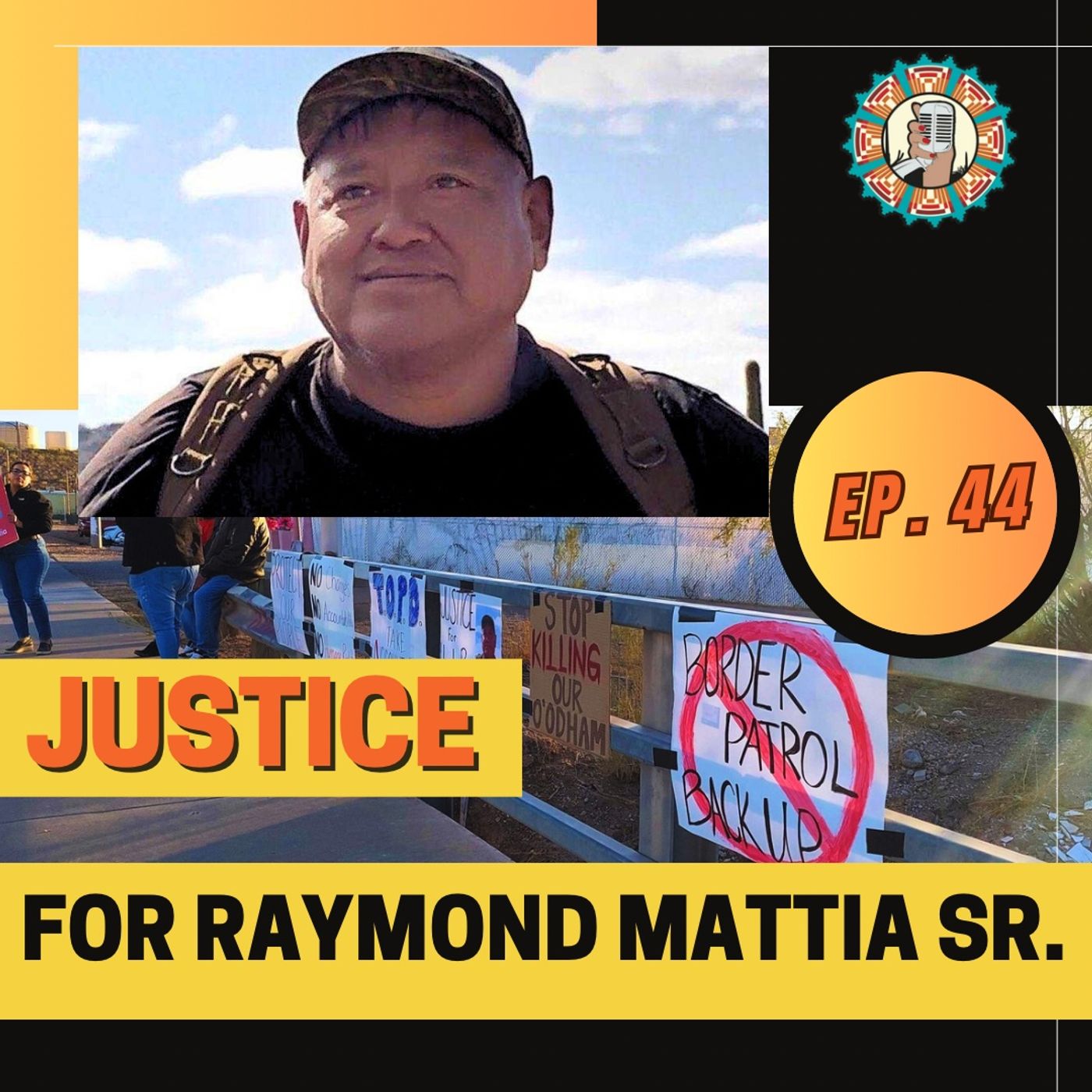
On May 18, 2023, Raymond Mattia Sr. (baht) a respected member of the Tohono O’odham community, was tragically shot and killed by Border Patrol agents. This incident, highlights the frequent and invasive interactions between Border Patrol and the Tohono O’odham people with the use of excessive force.
This episode highlights the family and community members that have organized peaceful protests, and are pursuing legal action, emphasizing the need for greater oversight of Border Patrol operations.
Raymond's death has brought attention to issues of accountability and transparency within the Border Patrol, his family has been vocal about the excessive force used and the lack of accountability, calling for immediate reforms to prevent future tragedies within the community.
There is a growing call for solidarity and support from other communities to raise awareness and catalyze societal change.This incident underscores the urgent need for a comprehensive review of Border Patrol practices, the family's advocacy for justice highlights the ongoing struggles of militarization across the Tohono O'odham Nation, may we continue to stand in solidarity with the family in their efforts.
*for NON O'odham listeners. (BAHT) is a O'odham phrase meaning to respect those who have passed and keep them at peace.
0:00 For full disclosure. The information discussed in this podcast is based on the views and experiences of the guests and the hosts. The content here is for general educational purposes only. Content warning. The following contains discussions surrounding experiences with Border patrol and graphic descriptions of violence and even death that may be triggering or traumatizing to some audiences. Please take care while listening. On the night of May eighteenth, twenty twenty three, down Autum Police Department responded to calls of gunshots fired within or around the community of adi Juk, also known as Manager's Damn Village on the Autumn Nation. During the dispatch call, a Autumn dispatcher is heard requesting assistance from the US Border Patrol Tucson Sector for Border Patrol agents to help respond to an end quote gunshots fired phone call. I first learned about the tragic killing of Raymond Mattia Senior bat from the news and other media outlets
1:30 and have since then closely followed this story. This fatal loss of a well known individual who was an involved community member in the village of Adijuk or Manager's Stem was another devastating awakening for many. Another tribal member killed at the hands of border patrol agents, another injustice blamed on the victim, Another autumn life cut short in relation into an incident with a US Border Patrol agent. The more I dug deeper into researching articles of past killings and incidentss with border agents that involved tribal members, the more I saw the lack of accountability, the lack of response and support for tribal members whose families have been heavily affected by their own personal experiences with border patrol agents, and the injustices that have become so normalized that when an incident happens, regardless of how big or small, oftentimes there's talk amongst community members, but never really no justice served, no peace of mind for autom who are affected. Having my own personal experiences, I know what happens when you get pulled over by border agents. Either you're met with guns strong that quickly escalates to demands and questions of who you are,
3:05 where you're going, where you're coming from, whose vehicle are you driving, where do you live, why are you driving on this road? Or you get it easy, no guns, polite attitudes, and then you're let on your way. You never know what you're going to get when you're faced with Border Patrol. And as I began to dig deeper into the incident with Raymond Mattia, I came across the video that also included a dispatch phone call between TOPD and the US Border Patrol. The dispatch phone call between Thaw and the police Department and the US Border Patrol Tucson Sector, which I watched from the YouTube video that was put out by the Intercept, was at first pretty confusing. I guess I was expecting for them to already know who they were looking for and mention Raymond's name, but none of that was to be true.
4:12 In fact, the dispatch phone call instead described an incident involving an ex girlfriend and boyfriend along with the ex girlfriend's mom, who they say were both shot the day before, and that there was a restraining order against the individual. People were hearing gunshots being fired, so everyone was calling in to check on the women since he does own a gun, and that the gunshots were heard coming from the west side of the rec center. Another part of the dispatch phone call that was confusing to me was the part where don Auton Police Department dispatcher says in quote, yeah, everybody said they report they hurt too.
4:57 Nobody can pinpoint where it came from. They are coming from the west side. Listening to that dispatch phone call and the exchange of information between TOPD dispatcher and the US Border Patrol twoson sector dispatcher, it wasn't very detailed and it lacked direction, which I understand. I get maybe they get a lot of phone calls and there's just bits and pieces of information that they get, so once officers or agents arrive, it's up to them to kind of pretty much just piece everything together. But I felt like that also was a key part of why things ended up the way that they did with Raymond. They didn't really have a solid way of going about this situation. Raymond Mattia Senior but was shot multiple times and killed with excessive and deadly forced by US Border Patrol agents outside his home in Ardijuc, also known as Manager's Dam, on the Thauna Autumn Nation, on May eighteen, twenty twenty three, just a day after his birthday. Raymond was born May seventeenth, nineteen sixty five.
6:15 He was fifty eight years old. The Thauna Autham nation is vast and very rule tribal police force relies heavily on the help from Border Patrol agents, who have also taken on a bigger role in patrolling tribal lands that oftentimes overshadows the presence of tribal police. The family of Raymond Mattia Senior Bot is calling on both the Thauna Autumn Police Department and Border Patrol agents to take accountability for their role in the death of Raymond. Coming up this week on Friday May seventeenth, at ten thirty a m. Their way be a press conference at the Tucson Federal Courthouse. If you would like to go out and support the family, please meet at the fountain on the west side of the courthouse complex.
7:12 We are now going to be getting into the interview hosted by Tina and co hosted by Brie, who sat down with two close family members of Raymond to speak on behalf of the family and on behalf of their uncle ray to share the truth of this unfortunate incident. Please take care while listening. My name is Evan Navarrees and I'm Raymond Mattia's niece. My mom is in at Matia, his older sister. I was born in Aha Arizona, grew up some in managers Dam or Audichuk and lived in Salis for a while, then moved down to Juson when I was twelve years old. Looking back on Raymond's life, what was life like for him? Growing up? He lived on in Ajo Arizona. He would go spend summers in Autichuk and with his other siblings, and he ran around just comfortable. He knew where he lived and the people who lived around him, and a lot of people knew him as he was growing up. So, growing up on the nation on the res, going out to our living and visiting Manager's Dam, how normal is it to see a border patrol in the area, even them going in searching around the village community. Growing up, I remember them being stopped on the side of the road a lot of times. If we were traveling to the store, we would get stopped sometimes and asked for identification and where we were going.
8:46 When I grew older and had my own family, we would go visit and go out and have picnics in the washes, and we'd be approached by water patrol. As time went on, it got more and more invasive. They put video surveillance facing the village where the border is like going into the village rather than placing it behind the village where the border actually is. So I felt like they were monitoring us and policing us. Is it one of the integrated fixed towers in that area? Yes, Oh, okay. Growing up with all of this around you, you know, with the border patrol and everything, did your family ever talk to you about it or give you any stories of things that happened to them or anything like that. Yeah, we all have stories or interactions with border patrol, but it was kind of just normal, you know. We would just say Okay, that happened and then move on with your life. And yeah, that's just was a way of life dealing with him. Hi. My name is Alicia and I'm Raymond Mattia's niece. I kind of want to give the listeners an opportunity to really learn, like, what was it like prior to what it is today for you as an individual? What were the changes and the impacts? When did it start impacting your life? Well, I grew up down there and managers, and you know, I think most community members who lived down there, who
10:18 grew up down there have had experiences or altercations with the border patrol. I myself was driving home one day and the Border patrol had stopped me. Was one Border patrol, and they had had asked me to step out of my car. So I stepped out of my car, and then he started searching all over my car, opened the trunk, just everywhere, and then he had told me that he had smelled where marijuana, which I didn't have marijuana in my car. And I think this was after when I had already moved into Tucson and then I was coming home for one weekend or something like that. So he said, you know, your car smells like Maria wanted heavily, So I'm going to call back up. He called back up, the backup came, they searched my car more, and I was there for like over an hour with them searching my car right in the middle of the village.
11:11 I think everyone maybe has had an experience like that, just like I have, and like Yvonne had said, you know, I think everyone just kind of got used to it. They just kind of let it happen and say, well, this, I guess this is part of the routine, this is life living down here. Everyone has had those experiences, but nobody really speaks up about it. Nobody thinks of it as you know, we shouldn't be living like this. I don't know if they think it's not a bigger issue, but it is a bigger issue because we shouldn't be treated like that because that's our community and we live there, and they're guests on our nation, and they're there for one thing, and they're there for, you know, to patrol the border, and you know, they're not watching us the community. They're supposed to be watching the border and they're supposed to be watching people are who are crossing the border. For me, I feel like there sometimes were after us for the wrong reasons, and we're the wrong people that they were going after, which was the community members. What is one memory that you have going back to when times were more simpler, when it wasn't so militarized. Do you have a fond memory of those times? No.
12:24 I think they were always part of my childhood growing up down there. They were always around, always, you know, m hmmm, they were always just there. It's so normalized their presence and what they do. And I feel like if there was a resource for us aught them from the nation, whether it's creating a program for helping us to deal with these issues and how to confront them, how to face them, how to move forward from them. I think that will be something that should be suggested. That's something that I've always mentioned or talked about, if we had some kind of resource for us to deal with the trauma, to deal with these types of experiences or feel validated by what we're all dealing with and going through. I feel like something like that would be super helpful. But going back to the day of Raymond's passing, Yeavon, how did that day start for you? It was a normal day here in Tucson, and I was getting ready for bed that evening and my mom called me and said they're shooting at ray and she was hysterical. I could barely understand her. And then she hung up, and I guess she was calling my other siblings because she didn't know what to do. And it was late and it was raining that night, so I know my sister Lisia and I wanted to go down there, but we had to wait till the next morning. And we drove down there, and I just couldn't believe it. I didn't want to believe it, even though I saw where he died and where it all happened. And I didn't want to
13:58 believe it was hit. I felt like, this is a mistake. He's gonna come out of the hospital or something. You know, it's very traumatizing. Your mom, you said she was there. She was right next door in the house. She lives right next to him. Yes, and she heard everything. Did she go outside or did she just stay inside and wait? She saw all the Border Patrol vehicles coming into her yard, and so she did go outside and she tried to figure out what was going on, you know, where they were going. And because they were all in our family compound, I can't imagine that whether it's your mom or your brother or your family member. And there are a lot of autom that just feel they have no justice, they have no peace. But I'm glad that folks are talking about it, and y'all are sharing your story anywhere you can with the great wider community. I think something like this, especially because of what was put out there. I think this is the first time that they actually released some video footage of what had happened. And even for me, it took some time. I knew it was out there, but I wasn't gonna watch it right away neither. It's a lot, it's heavy. You have to prepare yourself mentally and emotionally to be ready to talk about it or learn about
15:28 it. But during that time, also with your mom, how is she doing? It was very traumatizing for her. She was dealing with panic attacks and she still is dealing with the loss and what she heard and what she saw, and it's very hard for her, but she's doing what she needs to do to try and get his story out there too. When I found out I wasn't home, I had like several miscalls from my mom and when I did call her back, she was hysterical. I couldn't really make out what she was saying. So she kept saying border patrol, border patrol on Gray. And then I had told her called Donald the police department. Are they there? Do you see anybody there? She said, no, it's just all a border patrol. So I told her call TOPD and tell them that they're all going into your yard because down there in managers, border patrol are not supposed to enter your yard. So she called Donald the police department, and after that, I'm not quite sure what happened but I called his ex wife and I told her. My mom said, there's a lot of Border patrol present in al Grey's house and we don't know what's going on.
16:48 So I think she started calling around and then I heard from her and that's when that he was shot and I'm sorry, and then that's when we are then he was possibly dead. So I called my mom back. My mom is still hysterical, and then that's when just like the whole family started calling each other trying to figure out what was going on. That's when I called me Yupahn. I called my brother and I told them we should we drive down there tonight, and then I couldn't, so we did not. All decided to drive out there first thing in the morning. Kind of kept communication with my mom that night. She said there was just like tons of poor patrols, like twenty Border Patrol cars and the FBI and then all these different agents. It's up there, and my mom said that she was just her His children and two other close friends were out there near where the scene the crime scene happened, and they sat out there and they saw his body out there, just lying on their ground. Nobody was confirming if he was dead.
18:07 Or not, and and it wasn't until later until somebody comfort that he passed away, and they just kept him there till he really early in the morning, maybe like three o'clock. They weren't letting anybody out there, so you just lied out there until they came. He picked him up, his picked up his body. So it's really traumatizing. By myself, I try not to think about that day or that night, and obviously it's still traumatizing for us to think about it now. And even going down to managers, it's not the same. It's not the same because my alcar would always come around or we would go visit him, he would go hiking because and he was always part of part of whatever we did down there. So him not being there, it's it's a huge empty space and we missed him a lot.
19:17 I mean, the holidays was hard for me. It's just really hard going down there to managers now, I feel different. My uncle Ray was also part of the community Council with me. Him and I were both representatives, and he taught me a lot. He taught me a lot how the meetings are conducted and different things. And I was getting really close to him just because I was part of the council and he was already down there, so he was trying to teach me those ways. And he had a lot of respect for the people and really care for everyone down there, and he he was really trying to make change. He was trying to make sure everybody, you know, he was taken care of. I think my community lost a really good person, really cared for everyone. Thank you so much for sharing. I know it's not easy, and I appreciate you being open to this conversation and sharing your experiences. I know it's going to help a lot of people, a lot of aunt them who have endured the same pain and experiences with this situation. But I think this one, for sure, because it's so recent and it revealed something more than what had passed aught them who've
20:48 been killed by Bordo Pache. This one is more intense because it reveals a lot more people can actually see what happened that night, to really see what it's really going on. And I'm glad that you both have been open to sharing, and I'm glad to hear about the good things about what he has been doing, what kind of person that he was. There's just not enough set, I feel like of what he really truly did, I mean, there's some things that happen said, but to really see or know what he did for his community, the things that he was a part of, what he taught you, what he was teaching the younger generation and the younger people, how much he cared for his people, and for him to pass so tragically, it's just not fair. But during that time also, I know that it is pretty traumatic. How are you both dealing with the trauma?
21:53 I think the only thing for us to do is try and get his story out there. Try and because like at least Hea said, you know, he was always about the community. He saw injustices that were going on, and he was not afraid to talk about them. And I feel like this is just carrying on his legacy because I know if he were around and this happened to somebody else, I know he wouldn't standford. I know he would speak up about it and want things to change. And that's what we want to and we feel like, I know he was taken away, but he's still fighting even after his death. And he didn't die for nothing. So
23:47 after that night with Border Patrol and TPD, I mean when I watched the video, there was like it was unclear. It was pretty obvious that it was just unclear and they didn't know what was what and where do you even go? It was all like they kind of just guessed and went in a direction. I guess what was dawn Athum police departments? Where were they at if did they eventually show up? First, I want to say that we always knew my uncle was innocent, like before they came out with the video or before Border Patrol came out with their statement. We knew that him being shot was wrong because he's not the kind of person who would cause any kind of trouble for that force to come at him in that way. And we know Border Patrol agents are the one that shot him. But COPD has to take some accountability for what happened because they failed in protecting one of our tribal members. So what we have gathered from the video because we were shown by OPR, which is Office of Professional Responsibility, who are with Border Patrol.
24:53 They provided us the same edited video that everyone else was shown, so we saw the name that was redacted, the officer's face were blurred. We didn't get a lot of information from that video, and so what what we gather is that there was a done Notthum Police Department responding to a nine to one one call that was not recorded because I guess thrown note the police department does not record their dispatch calls or nine one one calls. The toped officer was responding two shots fired in the village. But what we do have recorded is when the thronot the police department's dispatch calls Border Patrol for backup, and she herself says that she doesn't know where the shots are coming from. We don't understand why they went straight to Maryamon and Mattia's house. We don't understand why the thune Othum Police Department officer didn't go investigate or ask any questions or verify where the shots were coming from. Straight away, he called Border Patrol for backup, and that's when at least ten Border Patrol agents came to back him up. At the point, the topdios for Sert lost control. He had no control over the situation. There are names redacted. They never say that they're going after Raymond Muttia. We don't understand why they redacted his name.
26:12 We did try to ask another office that we met with, and they said, yes, we saw the unedited video and it did say Raymond Mitia, but I can't say for sure because I didn't hear it myself. Yeah, they came out guns drawn, as if walking into a war zone. There's family homes in that same proximity, and so when one of the officers says there's something in the bushes that could have been a child, and he could have easily shot a child at that point. When they went up to my uncle Ray's house, they didn't see if anybody else was inside the home. They didn't try to de escalate with voice commands at all. They kind of just everyone started shouting at him, and when they told him to take his hand out his pocket, he took it out to the right and not toward the officers. So when they say they felt it was there was danger, I don't understand or see how. I think they're just trying to cover up what they did. And the fact that they shot at him that many times and shot him in his body that many times, it's excessive deadly force.
27:22 So I don't understand why they were not prosecuted either. And thank God that his kids were not there. With him in his home because they would have been shot at two because bullets went through his wall into his home. And like you said, there should be some kind of program, you know, to help with this oppression that we are facing. But I think TOPD calling Border Patrol for backup now is moving in the opposite direction, Like how are they giving them the right to shoot at our people when they're supposed to be the ones handling civilians in the situations going on there? But they refused to take responsibility during all that. The detective, I believe the one that you he was working with you a or was he just like a contact person that you Lieutenant Daily. He was there that night after it all happened, and he was in communication with my mom for a while. But after they met with us because when they showed us the video, it was OPR TOPD detectives and FBI agents. So after that, we haven't heard anything from them, and we've tried reaching out to them, but no one is responding. How long has that been now, Yeah, that was June. I think it was in June. Wow, that's a long whole mean we're almost there a year pretty soon. And then the US Attorney's office wanted to meet with us as well. They had FBI representative, US attorney, representative, liaison for
28:59 tribal government and US government, but it was basically just to tell us that they were not pressing charges. We tried asking questions that we've been wanting answers to. What are those questions? If you could ask those questions again, what are those questions that you want answers to? We asked why the thoughnoth And Police Department didn't verify if the shots were coming from Raymond's house before calling for backup. We asked if the US government or tribal governments plan on doing anything to prevent anything like this from happening Again, We asked why weren't there nine to one one calls recorded? Why did they show us the edited version of the video? Why did so many officers go out that night? Why did they continue to threaten to shoot him when he was laying on his face dying. Do you remember anything else? We asked him to confirm the number of shots fired, and and they won't tell us. They were basically defending the border patrol officers already by not answering any of our questions. So when was what was the date. It was May eighteenth, eighteenth twenty three.
30:15 During all this time, all this stuff has transpired, and things are kind of at a stand still at least when you're dealing with the Border Patrol TOPD and what the decision that they've kind of already made. I guess, you know, them saying that they're not going to prosecute, so they're just moving on from there. But you all are continuing to share his story. What other goals did you have in mind or what kind of justice are you seeking from this experience. When we met with the thrownoth And Police Department detectives, we asked if they are going to reconsider their relationship or their procedure when calling Border patrol for backup, and he said, well, we're short staffed right now, but I don't underst and way they can't use like the Sheriff's department or any other peace officers around the area instead of calling for Border patrol.
31:07 Because Border patrol are not trained the same as police officers. They're not held accountable. If you notice police officers when they shoot someone or kill someone, their names are immediately released. We still haven't heard the names of these Border patrol officers, they get qualified immunity and de facto complete immunity. They're basically immune to harassing and even murdering our people. And I know officials say that it's because they need to feel comfortable doing their job, or are they in the business of murdering people, because that's basically what they're protecting them from. We also would like to make people aware of their rights. Like I said before, you know, this is just how we've lived and we always knew there was a problem with Border Patrol, especially interacting with them, but we didn't realize how big the problem was and until it happened to one of our loved ones. And so we want, you know, people to know their rights, know that they have a voice, Know that you know when something's bothering you, it could be the smallest thing, you should use your voice and say something and speak up about it because it could get worse. And it is getting worse, and it's not a matter of if this is going to happen again, but when. And we did voice our concerns with some of the unprofessionalisms that Border Patrol officers were conducting that night toward our family when it happened, and we did tell Lieutenant David Daily, he offered a one
32:38 eight hundred number to my family to complain about it. That's not enough for us, you know, it's not enough for to leave a recording about what happened and then because nothing will get done. And like you said before, there needs to be some kind of help for us, some kind of office, some kind of place where we can actually go to talk to people about it, and we would also get like to get more statistics as to like how many times TOPD is using border patrol for assistance or I feel like that data is not out there, is not released, and I feel like if people were to see that more then they would realize what a problem it is.
33:19 Yeah, I think that that definitely is something. And I've been you know, talking about voter issues for a long time, and it really for me, it started when I was in college back in twenty twelve and at the time, there was a story that came out and it was about a grandma who was going through the boat to patrol and just because of their aggression and they you know, they want immediate answers, they want immediate responses to what they're trying to ask you to do. And because she was elder, she couldn't maybe she didn't understand, or she was moving too slow, and they got impatient with her and they cut her out of her seatbelt and they bruised her. They showed her on the front page of the Runner with her bruises, and for us, that's when we started to really raise awareness.
34:05 But I also think that putting pressure on our leadership as well as a community as a people to really voice her concerns, to really show what it is that we need from them, Which is that protection, which is that resource, which is that support, is something that is really needed as well. More folks speaking up, more folks going to their community meetings and addressing these concerns. And I know throughout the years they've had town halls where border patrol is there. But five minutes to talk on a microphone to share your traumatic experience is not enough time. And accountability is at the top right there for many of us, it's been too long. It's been a long time coming, but hopefully something can change. Going back to Detective Daily, was he like the detective that was assigned to this or was he just there that night?
35:00 Said that he was there that night. I think maybe he was maybe the only detective there that night. And the lack of empathy that he showed, and the way he gave my family a one eight hundred number to call if we have any questions, I think that's really sad. But yeah, he was the only detective there that night, and I think he might be the only detective on the case. If you felt maybe you weren't getting enough information from him, were you trying to go to other like calling the police department and talk to someone other than him, or did you only have to go directly through him to talk about the case. I believe he was our main point of contact ever since then? What has happened now? I know that you guys recently did some protests like peaceful protesting. Is that something that you want to are going planning to continue to do? Yes, definitely, We're going to definitely keep doing or planning peaceful protest just to keep it out there, keep what we're doing out there, keep what we're trying to voice out there, and hopefully bring some change, because I know my uncle Ray would keep pushing for this for change. With your uncle Ray prior to that day that night, what was he up to during that time. I know during that time he was working on getting the ceremonies together and he was teaching
36:30 because not a lot of the kids down there, Well we're running out of singers down there at the ceremonies. So he knows the songs, so he was actually helping teach other people the songs. That way, our traditions can be carried on and carried further. That's what he was doing. Wow. Unfortunately, you know, another person, traditional knowledge carrier just taken from us like that is unfortunate to hear when everything happened that night. When I watched the video, and again you hear the conversation of the dispatch, you kind of see the gathering of them before they all start making their way that way, and they are kind of guessing as they're going through the trees trying to find something. And I feel like the first person they found was who they were going to target it. Unfortunately it was your uncle Raymond. And in the video, all he did throughout that entire situation was cooperate. He didn't resist, he didn't do anything that he wasn't told to do. He was simply doing what he was being commanded or told to do, and unfortunately that still wasn't enough for them to feel like they were in danger. And I don't understand that neither, because this is one guy, this one person, and there was like a bunch of them surrounding him. Yeah, he threw any but again it's only because he was cooperating with them, and unfortunately they
38:06 immediately just the aggression that they showed how they were talking to him, even when he was shot, when he was down, when he was bleeding, when he was fighting for his life, they were still treating him bad and talking to him in an aggressive, vulgar way, you know, cursing at him. This is a person who's heard, who's been shot. He's not posing any harm when he's in the state. But for you to continue that aggression even when somebody's in that situation, you could just tell that they were panicking as well when they started to talk about the gun. Can you talk about that situation with that, Well, he was unarmed, and they were panicking because they were saying find the gun, find the gun, because there was no gun, and he did receive a broken arm after he had been shot over nine times. So I mean that's how much force they were using.
39:00 And trying to turn them over and find the gun. And yeah, that wasn't right to shoot an un non man that many times, and it was pretty obvious there was no gun. There was a cell phone, yes, but there was no gun. You know. I guess two things. How has your community and like tribal leadership respond meto this and just like other events, just because I'm not really familiar with how it is, especially you know, with their relationship with the border control and like just this long history of them interacting with your guys, community and your people. So that was my first question. So well, we feel like Ned Norris was trying to be very diplomatic about the whole situation and not take a side, but we feel a little more supported by Verlin Josse. He's, you know, with his words. He said that you know, this isn't right. We need to do something about it. So we're hoping that he keeps his word and he's willing to help us and getting some changes done and talking to legislative in the future. And he has also been very supportive about, you know, us getting our word out and my uncle Ray's story out, So we do feel supported in that way. On the smaller community level, I feel we're not very supported being on the council and managers. I feel like no one's really talking about it. Nobody reached out to me when the incident happened.
40:24 Nobody released their condolences. So I don't know if people in our community, I don't know if they're scared to speak out, are scared to feel for the situation. Maybe they feel like if they do speak out that they'll be targeted because you know, before that night, I cannot recall one incident where there was a presence of water patrol like that, the amount of water patrol, the excessive force that they showed, I cannot recall one incident where a situation happened that way. So yeah, I think maybe it was traumatic and traumatizing for the whole community because people are still, you know, they're not really supportive about it, but they're talking about it. Elderlies are starting to come out and say I heard the shots that night. A lot of the community members are coming out seeing they heard the shots that night. I think for everyone it was kind of traumatizing. I know one elder came out and said that he heard the shots and he ran inside because he got scared, and this man lives maybe half a mile away from the house from Ray's residents.
41:36 So I think the whole community heard what was going on, and I think they're afraid to speak out. Within the community, we haven't really gotten any support, but on a bigger scale with the nation and Verlin Jose, he's been pretty supportive, so I think we find comfort in that. Thank you for sharing. I guess my second question would be for people either in or outside of your guys's community. You said that you guys do peopleful protesting. How would you like people to give you support and like where would they be able to go to find more information about this about you guys, well, how they can support you guys in this whole fight, I guess against the border patrol and how they interact with your people and what they've done to your people. We'll definitely keep an eye on Facebook. If we're going to do something, we post it on wherever Native Americans can see it, because we would like to see more support on that and I feel like it would be loud or I feel like it would be more impactful if more of our people were standing out there with us. Yeah, we would love to see that, and like Yvonne said, we try to go to social media.
42:49 We try to join anything that has to do with victims of border patrol. I feel like we've made progress and we've networked with a lot of people so far, so I feel like what we've been doing has been working on social media. We try to put our phone numbers out and contact information out there. With everything that we've kind of discussed and just kind of talked about, what are your plans for this year in regards to continuing to raise awareness of your situation and for justice and in what ways are you seeking justice? What kind of justice do you want for your uncle Raymond. We do have attorneys that we are working with and they are working on getting as much information as they can as far as like the video and names of officers and everything, but we know that could take years because it's going to come all together the information, So we would like to try and work on getting information from individual agencies as we go. Like I said, we've never been a part of anything like this before, so we're fairly new and we don't quite know where to start all the time. But we have people like helping us trying to tell us where to start. So I think information is huge for us this year, more peaceful protests, just to keep everyone aware that we are still living through this and fighting for this, and we want to make them aware that there still are Bordertrol victims, you know, on all sides of the
44:22 border, and just to keep his legacy alive awesome. Would definitely be keeping a lookout and continuing to share on our platform, continuing to share his story. But people just need to be reminded every now and then, you know what happened and what's still happening now. But if you have any last thoughts, anything you would like to say, yeah, before we end, we just want accountability. We want someone to be held accountable, and we're going to keep his legacy alive and we're going to keep talking about it and we're not going to stop. If you wouldn't like to learn more about upcoming events and stay up to date, you can check out the Facebook page Justice for Raymond Matia at Justice dot FM dot Raymond dot Matia