 Apple Podcasts
 Spotify
 Castro
 RSS Feed
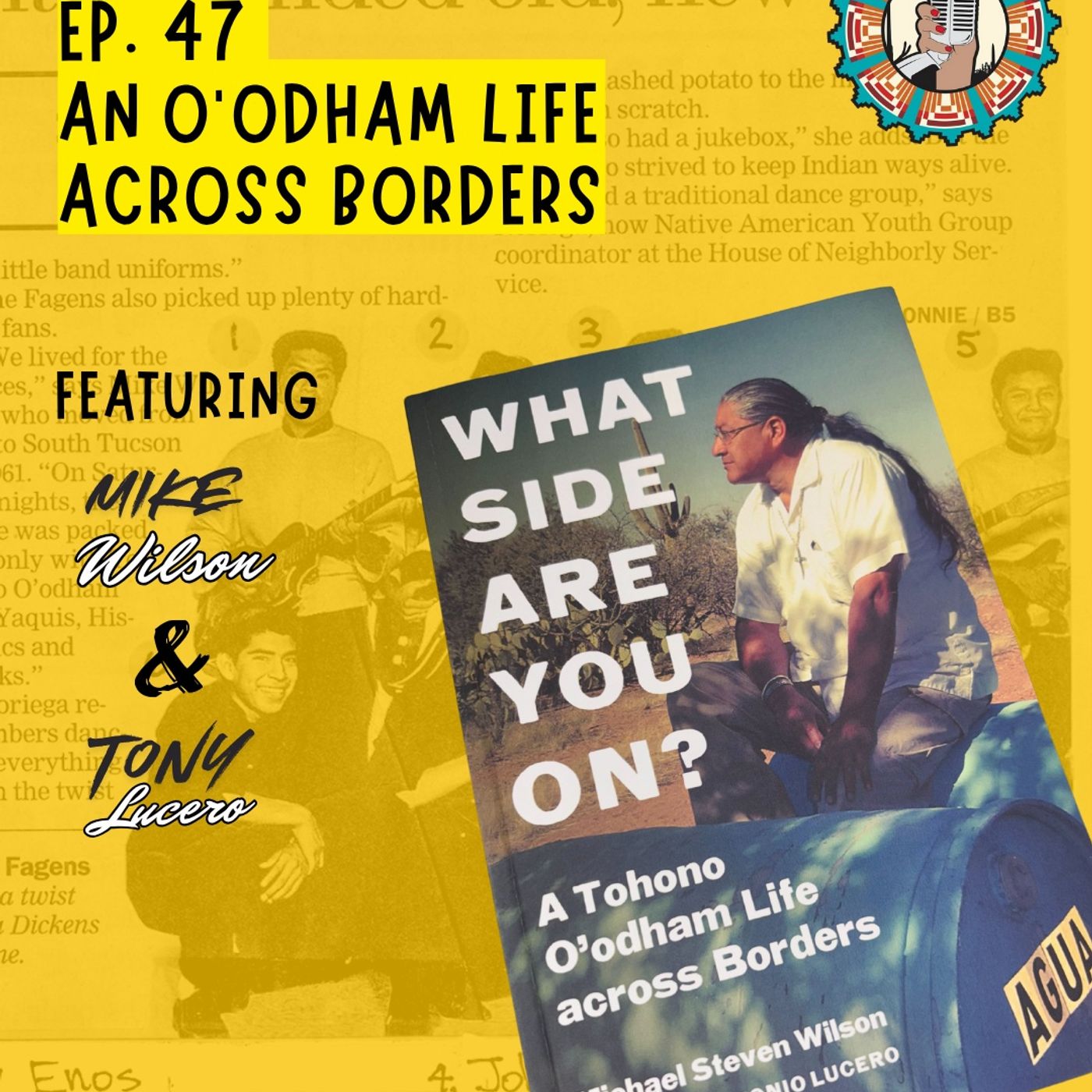
This episode features author Mike Wilson (Tohono O'odham) and co-author Tony Lucero who wrote the book https://uncpress.org/book/9781469675589/what-side-are-you-on/ In our conversation Mike shares pieces of his life story and Tony talks about his...


This episode features author Mike Wilson (Tohono O'odham) and co-author Tony Lucero who wrote the book "What Side Are You On? A Tohono O'odham Life Across Borders." In our conversation Mike shares pieces of his life story and Tony talks about his interest in not only Mike's experiences, but also the history of the work he's been involved in overtime. Mike spent his childhood in the small town of Ajo, Arizona, which is located northwest of the Tohono O'odham Nation in Southern, AZ. Living throughout the Southern Arizona border, Mike felt a responsibility to provide water stations along the border region on the Tohono O'odham Nation to provide a drinking source for migrants passing through tribal lands to help saves lives. In our conversation he also shares stories about O'odham life during the early 1960s when he and his family lived in Tucson, they enjoyed spending time with family and friends listening to live music at the Tucson Indian Center and playing records at a friends house with other O'odham kids. The discussion covered many things from politics, to O'odham lifeways, and music.
Co-Author Tony Lucero, is the Chair and Professor of the Comparative History of Ideas Department at the University of Washington, Seattle. He shares his thoughts about why he became interested in Mike's life story and how the work Mike was doing throughout the border was an important one to share with his own students. Many times Tony invited Mike to be a guest speaker in his classes and it was Tony who suggested to Mike about writing a book!
Since the release of the book Mike and Tony have been on a book tour, which is where I got to meet them both in person when they presented at the Mission Garden in Tucson just this passed spring.
Helpful Links:
The Latinx Project - Book Panel: What Side are You On? A Tohono O'odham Life Across Borders
NAU discussion explores Tohono O’odham border issues
Global Visionaries: Tony Lucero
From Green Beret to Border Human Rights Activist: A Podcast with Mike Wilson and José Antonio Lucero
Tohono O’Odham activist plays himself in this new movie about migrants crossing the Sonoran Desert
0:00 For full disclosure. The information discussed in this podcast is based on the views and experiences of the guests and the hosts. The content here is for general educational purposes only. Have you ever heard stories of autumn recollecting their memories of living in the Motown era? I guess I never really thought about it, except for the one time I asked my late grandma Annie who her favorite singer or musician was growing up, and she said Elvis Presley, which is not a part of the Motown era, in case you're wondering. But over the years, in hearing so many autumn telling their stories from different time periods in various forms such as writing in person, voice recording, video, recording, newspaper articles, I learned that autumn have always evolved with the times and adapted to mainstream society, from the music they listened to to the clothes they wore.
1:29 Not saying that. It was easy, Authom always had to fight fight for certain rights, whether it was for land and water rights, the right to vote, fighting against opposing infrastructure projects, border issues, resource development, and other political challenges that the nation still faces today. We as Native people have a rich yet complex history of evolution from cultural exchanges, diverse environments, and of course European colonization. The interview you are about to hear.
2:11 Is about a book which I would say is a great example of just that. It explores storytelling from the life of Mike Wilson on Autumn and his life experiences and stories told by his elder Hodgen over time, and then of course him experiencing his own personal journey in life up until now, and the fact that he had an opportunity to write about his life story is amazing. The more books and storytelling and authors we have, the more authentic our history is. I hope you enjoy this interview featuring Mike Wilson and his co author, mister Tony.
3:04 You are listening to on Autumn Young Voices podcast. I'm your host, Tina Andrew. Thank you so much Tina for the invitation for Tony and I Mike Wilson here. Tony Lucetto is my co author. But I just want to thank you for including me in your all Them Young Voices for a seventy something aut them. I take that as a compliment. Thank you very much. I'm authom on my dad's side and on my mom's side. I'm also Kashan, but I grew up identifying as Autum first and foremost. I was born at Center Beer in nineteen forty nine, but I was raised in Aho. After the fourth grade, we moved to South Tucson, and so I went to the public school system in Tucson from the fifth grade through high school, and then I started at the U of A. And that's as far as I got. I started. And yeah, So I had a military career, and I had a small, a short teaching career, and after the military, a short teaching career in San Antonio, Texas. But my parents were getting
4:34 old in the early nineties, and I thought, well, if you expect to spend any time with your parents, you better go home. So I moved back to Tucson in ninety seven. And my co author is Josse Antonio Lussetto. He hales from the town the border town of El Paso, Texas. A man who needs no introduction. No, I think you're confusing me with you, my. No. I wanted to thank you as well. Tina. It's really great to be here. We're big fans of the podcast, so it's a real honor to be in conversation with you. As Mike said, I'm just I'm just from down the road in al Paso, Texas. I grew up in all passunsu Huades, Chihuahua. Both of my parents from Mexico. I'm a Chicano a professor. I teach at the University of Washington, Seattle. My academic field as Indigenous Studies and Borderland Studies, and I've been at the University of Washington for about eighteen years. I'm the chair of a department called the Comparative History of Ideas, and I also teach in International studies, American Indian Studies, and geography.
5:41 And it's been a great treat to work on this project with Mike over the last decade or so. Thank you both so much for the opportunity to share your guys story with his book, and thank you so much for reaching out. And I think it's an important narrative to the Autumn life. And I was really happy to see just even the title in itself a thaw on all of them life across borders and we all have a story, especially even though I'm sure our Passo was like the boorters right there. So I got a chance to read some of your book and just what I have read, it's been really interesting as a young person to learn about what the life was like in the nineteen twenties, nineteen forties, nineteen fifties, sixties and just imagining what that was. You know, I'm not sure like for young people when we think far back, how what like we were still in the times?
6:41 You know, it was still the times. We're dressing more contemporary like what those times were. It was like we weren't what other as far as like historical pictures of us by the water and harvesting and doing all that stuff. Time we were evolving with the times. That's I guess that's what my point is with that we were evolving with the times, and just to hear and learn more about these areas, these familiar places Aho, Arizona and here in Tucson, South Tucson was just an interesting what was happening even as young people like yourself back then, what you all were doing as young people with listening to music, listening to records, hanging out with each other, where the families and the parents trusted each other and that sense of community was just there and it was exciting even with television you know, spending time at someone's house watching TV for hours, because not everybody had a TV in their home back then neither, so those things were just really interesting to me. And it reminded me a lot of my own mom because she told those similar stories where she would go to a relative house who had a TV and enjoy watching TV.
8:04 It was just really cool to learn about the lifestyle of an autumn. But what this book really to me at least, it really is your life story because it starts from the beginning and just going through different stages in your life. And you've accomplished and done so much in life. Even from up to what I've read, it just seems like it's a lot, and you're still doing what you're doing and still accomplishing certain things. And you accomplished publishing a book telling the autumn narrative, telling the autumn perspective from a community member who's lived a life, and I really appreciate that. So you said that you've both known each other for some years now, what made you decide that you wanted to write this book?
8:51 Mike, Well, it was really Tony's idea. Now we met here in Tucson at a conference two thousand, I believe, and he invited me to lecture to some of his students in Seattle. So about five years ago we were having a conversation and he said, Mike, every time we came to Seattle, or every time I came to Tucson, every time we talked, I interviewed you. I recorded everything. I have so much recorded material. We He didn't say I have. He said, we have enough material to write a book. Are you interested? And I jumped at the offer because as a public speaker, over the last twenty five years, after my presentations, many people have come up and said, Mike, are you writing this stuff down? I said, no, why Mike, You're a storyteller. You need to write your stories down. And at the time I said, who cares?
9:56 Thank you? But really who cares? And so I never was interested in writing a story. And I guess maybe it comes from that authorm tradition that you don't speak highly of yourself, you don't promote yourself, you don't exalt yourself, you don't you raise yourself above the above anybody else. And so until Tony said, you know, are you interested? And I thought about it. I said, yeah, I've got you know, I've got some stories to tell. So that's how we started that. And thanks to his saving all the material, all those recordings, I mean everyone. So when the offer came, I jumped at the offer. Yeah.
10:46 I just add a little bit more context. When we met, as Mike says, by chance here in two signed a meeting of the Native American and Indigenous Studies Association when the annual congress was held here. And I had already known about Mike's work through the many documentaries he was in, especially the first one, Walking the Line, which is available on YouTube, and it's mostly the story of anti immigrant vigilantes, but Mike is really the kind of moral conscience of that film, showing the response from the social justice community and from an awumb perspective too about how the border migration policies are affecting life on the nation. So that I used that documentary in teaching for many years. So when I saw Mike, and this is you know, something that I kind of say often, I was starstruck because you know, for me, he was a celebrity. You know, he was Native Tom Cruise, you know, And so I said, you know, you got to come to U Dow, you got to come and talk to my students, and he did, and so we though some of those things we recorded with Mike's permission, and then there was again kind of a coincidence. I got invited to participate in a scholarly workshop on religion and politics, and Mike's life is really a lot about that, about the intersections of religion and politics, and I asked Mike, I said, hey, I'd love to work with you on this article to talk about how you know your journey through this religious life, and we'll get into more of the twist and turns of Mike's life in a little bit. And one of the things
12:17 about Mike's activism was that it was a very lonely kind of activism. You know, Mike was putting out water on the reservation for twelve years for border crossers and doing it a lot. Of the times by himself. And I have a background and thinking in social movements and scholarship of social movements, and that's by definition collective, and so as a form of activism, it struck me as a really lonely and one of the religious scholars there he kind of broke it down for me, says, Mike is operating the prophetic mode, you know you're in. When you're working in the prophetic mode, you're speaking a bigger truth that often will create resistance in your local community. And that's why it looks that way it does. And I share this with Mike, and Mike said, well, if you want to call me prophetic, that's fine. I'm not going to call myself that, but I'll take it. And then the more we talked, the more we realized there was a lot more to the story. And that was the foundation for just hours of world history that we did both here in Tucson and in Seattle. And after enough time, we realized we had a lot of material and enough for a book, and that became We talked about how it could be this conversation between the archive of Mike's life and all of these academic texts about indigenous politics, about US foreign policy, about religion in the Indian country, and immigration politics as well.
13:38 You know, as a young person. Growing up here in the southern region of Arizona, both in Tucson and on the on the nation, I feel like, I mean, I'm sure there was more a little bit of presence here and there, but for me, I feel like I remember like really seeing border patrol patrolling our row. I had to been like thirteen years old, so that might have been like nineteen ninety nine. I think around ninety eight ninety nine, And that's like my most accurate memory of like that's when I realized or knew like that theyre or were absolutely present, and never did I think that they were.
14:22 They would still be here. And here I am, as you know, later in life, and it's just where it's gone to where it's at today. So it's always interesting to just learn about the different things that have happened over the years, the impacts that these border situations and militarization. And for me, in two thousand and twelve, around that time, I was in college and me and my group of friends in college, we did a little organizing surrounding border harassment because at the time it just seemed to be like really increasing and it was affecting a lot of people and families. And at the time they were also doing town halls, which they were only giving people five minutes to talk, and so we decided to do a march and down through Cells, starting at the Bashes parking lot and walking to the White House in Cells. We just wanted to make a statement as young people, and we were also tired of the harassment and what we were hearing and experiencing ourselves.
15:34 So I've been in a lot of different situations when it comes to border patrol as well when it comes to border It's a story that I want to keep. Is definitely the foundation of the podcast. What prompted me to create a podcast was when they started talking about the integrated fixed towers in twenty sixteen and they had the environmental impact statement out, and what we were hearing from community members was that voter Patrol was telling them that these structures were going to be just temporary, but yet in the impact statement it was permanent. It was clearly black and white there it was. But they were telling community members other wise other things that they wanted to hear, I guess. So that's why I was like, Okay, well let's find let's utilize this platform and we'll share our stories. And it's just kind of evolved into what it is today. But this topic has always been an important to me and to share, and so I want to get a little bit more into into the work that you've done surrounding the waters. Mike and you can start wherever you'd like with that.
16:54 Yeah, I started putting out water on the nation I think early two thousand and two. At that time I was a Presbyterian lead pastor at the church and Cells. But before I left Tucson to go to Cells, I was attending Humane Borders meetings here in Tucson, and Humane Borders then and now puts burrows of water out in the desert. They've asked for and were denied permission to put out water burrows on the Throne autem Nation. So when I got to Cells and I was looking at what we called then and now the death Maps, and what it is is it's a colored map of southern Arizona of the Tucson sector of the United States Border Patrol, which includes the Throne autem Nation, and on it are red dots. Each dot shows where human remains were found undocumented migrants, where they died, and where the remains were identified or at least found. Humane Borders got that information from Pima County Office of Medical Examiner. Because when they remains were found, they were moved to Tucson, that became part of public knowledge. So Humane Borders got that information from the office of Medical Examiner, and at the end
18:26 of every federal fiscal year they published the death Map. And this is probably nineteen ninety nine two thousand, I saw the very first iterations of the death Map, and to my embarrassment, as an authum, I saw there was a cluster of red dots in the Babequirie Valley as is traveling south to north, the north being Ajo Road being the northern edge of the Babequree Valley, immediately south of Ojo Road, there was a cluster of red dots. There were so many that they were overlapping each other.
19:08 It looked like a cluster of grapes. There were so many migrants deaths in the Bubblicare Valley, and I knew that the social justice community at that time no more deaths. Samaritans of Tucson human borders, all of them were denied permission to put up water on the nation. And so when I got out there and I had in my hand this death map, I mean it was I was embarrassed. I was humiliated that on that map. I said this twenty five years ago, and I will say it now.
19:48 I estimate that conservatively fifty percent of all migrant deaths are on tribal lends. So I thought it was my moral responsibility as a human being, as an authorm, and finally as a presbyterianly pastor, that I had to do something on tribal lends because the nation knew. Everybody knew that migrants were dying on tribal lens, but nobody was doing anything about it. The hospitals, fire departments, ems, the churches, nobody. They didn't want to talk about it, so they allowed migrant us to go on and on and on, and I said, I can't let that stand. You know, as authorm, we have the tradition of hospitality. As much as we can.
20:37 We do offer food, water, and it's sometimes sheltered. I know that goes on in the nation. I know tribal members want to do more. But it finally got to a point after several years that the autumn people and the tribal police couldn't accommodate even if they wanted to. The sheer numbers of migrants crossing the nation per day. Police Department estimated maybe this is maybe two thousand and four, two thousand and five, that one thousand, five hundred undocumented migrants were crossing the nation daily. So where I was putting out water in the Barbakabe Valley, I would take on a weekend anywhere from six hundred to one thousand, three hundred gallons of water, and I couldn't keep up with the volume of water that was being consumed by migrants.
21:32 They needed that water, and so I did that for twelve years, and then finally I got to the point where I realized the water was not being used anymore. And one of my friends from San Miguel, my dad was from posover chutuquehe on the Sonora side, and my friend said to me, Mike, you know you can't go back to your dad's wrench at Chuttoguoha. I said, He says, it's been overtaken by cartel, that your dad's house is now a storage warehouse for bales of marijuana and it's guarded by armed guards with eight forty seven's. So now I understood why my water was not being consumed after ten years, eleven years, because one of the cartels on the Mexican side was stopping the flow of migrants coming to the Barbecuee Valley. So for operational purposes, if you have a cartel, on the Mexican side controlling the ground, and you have the border patrol on the US side have an operational control of the land. So there were two barriers which were prevented migrants from coming through the Barbecue Valley. Therefore they weren't consuming my water. So I finally it realized. I said, you know, it's it's futile to stop putting it out water after twelve years.
23:03 Wow, that's really interesting. And I had heard or known of you doing that with the water, and it was good. I always looked at it as a good thing because you're right. There are out them out there that do want to help, you know, and they if they have water, if they have some food, those exchanges do happen, and it's not that they're doing anything bad, and they're just feeding people who are starving and who are thirsty and letting them go on their way to wherever it is that they're heading to. These people, it's interesting and as a part of your book as well, going back to the book from what I had read in the beginning, you talked a lot about your upbringing in Aho, and you talked about your your grandfather as well, who again who live lived in the community in Mexico.
24:03 So is that where you grew up? Was or was it in the states? Here? No, I consider myself Aho. I consider it is my home. Okay. Yeah, And what I've. Been saying lately is you can take the boy out of Oho, which you can't take Aho out of the boy. And so uh again, I was born in Santa Vier early in my life. I don't know when. Okay, we were living in cells for a while and then and then we moved to Ajo. So I remember living there until the end of the fourth grade, and then after the fourth grade, then we moved to South Tucson. So uh yeah. But I still consider Aho my my hometown.
24:49 And I go back to Aho maybe twice a year. I go up to the village. Because many people might not know that a Hoo was a very segregated town even in the nineteen sixties, and this was by design. When Ajo was founded circa nineteen sixteen nineteen seventeen, you can still find the planning maps for the township of Acho. You could see that Mexican and Mexican Americans were isolated in the community of Mexican town. All of them were segregated in the community of Indian Town, which became Indian Village, and then Anglos were isolated or separated and their community was called American Town. So by design nineteen seventeen, it was designed to follow a racist pattern. So I actually grew up in the village, probably through the first grade.
25:51 I was even an altar boy at Saint Catherine's Roman Catholic Church. Saint Catherine's is now the whole museum, But when I go back to the village, when I enter the building, to me, it will always be Saint Catherines. It's one of my sacred sites. And there's the shrine up on the hill behind Saint Catharines is another of my sacred sites. Before my dad passed away, I took him to Saint Catharines, and I took him to Apfel because he wanted to visit it. And so I have fond memories of taking my dad up there and revisiting.
26:32 So to this day, Saint Catharines is is one of my sacred sites. And then we moved to Tucson. It wasn't until I got to Tucson that I realized how poor we were. Oh, but before I forget my dad worked briefly for the Pelops Dodge Mining Corporation, not in the mine or not in the mills, but he worked at the public school. Matter of fact, he didn't he he was one of the maintenance workers. And then he lost that job. So when he lost that job, he also lost company housing because all of the village was company housing. If you worked for Phelps Dodge Mining Company, you were entitled for housing. So we moved from the village to Mexican Town. So between those two, those two communities, that's the Aho that I know. And so that's why I said that's that's that's where my heart always has been at Saint Catharine's and that the autom community there.
27:35 Wow. Yeah, that's definitely another thing that I've learned about is you know, over the years of hearing other Autum telling their stories of Aho. So learning more about how much Autumn were involved in the community and how it's just been a part of Autumn life as well connections that it has has been really interesting to me too, because Aho is a really well to me. It's a small town and you mentioned something earlier this morning about how it is now like border patrol community type place what. I call it is that the main employer in Aho in the United States Border Patrol because they have a huge detention facility out by the Why but government housing is in Aho, so now there are so many Border Patrol agents and their families living in Ajo. Border Patrol is the biggest economic driver in Aho. And that's a reality.
28:42 That's how big it is. Which again is just it's also just interesting as well, like the changes and the impact that this international border has on our lives and the changes that it's you know, how it's impacted those changes as well. What do you have any thing you want to add in regards to your part in co writing this book. Thank you for allowing us to talk about Aho, because it's actually one of the parts in our many events that we don't have time to chat about. We quickly get to the kind of the two thousands and the migration tragedies, which of course are important, but this initial part of the book sort of illustrates what we're trying to do. So in the book, Mike tells his story in the first person pros and it's very compelling. And then in between his chapters, I have these interludes which zoom out and kind of put Mike's story in conversation with the history and the politics the culture of the times that he's talking about. So as Mike talks about growing up in a Hoo, as Mike said, this really shows the particular way that modernity comes to the to Arizona because a Hoo, the Phelps Dodge Company, that is the site of the first open pit copper mining town in Arizona, and it is then the city of Ahoa, as Mike also just said, is intentionally designed as a progressive space. It's kind of the city's beautiful movement of
30:13 the United States at the time, public libraries, swimming pools. I get seen as a modern but what that means modern progressive means racial segregation. All that comes together, it also means environmental devastation. Mike tells the story of his younger brother who passes. Is it your younger brother, tych Yeah, So there's a tragedy in the family that's related to the environmental damage. And so just very briefly, what we want to talk about is what we call the Boomtown lessons. The first boomtown was this idea of copper and prosperity, and how that form of racial capitalism has a high cost. But the new Boomtown, as you all were just mentioning, is the border patrol boomtown and what that looks like, which is also racialized. Also government and contractors making money at the expense of a lot of poor, racialized communities.
31:07 So those those Boomtown lessons really kind of show the old but many of the dynamics remain really toxic in ways that are historically different. But there's a there's a kind of a through line that we can trace there. Quick break. If you're enjoying the episode and want to dive deeper, check out the episode description. I've dropped some helpful links and extra info, whether it's resources we've mentioned or ways to connect. It's just a tap away. Now back to the show.
31:58 Yeah, you know, without giving away too much of the book, you can read all of what we're talking about, and what Tony just mentioned, and the tragedy that did happen with Mike's older brother, with the environmental impacts of you know, these types of things. You can read that in the book. And yeah, so it's just a really interesting and intricate way you both have managed to kind of guide your way through these different stories in different timelines and different periods. And the book also includes pictures, which this one, by the way, I'm looking at it right now, just because I recognize you. You mentioned in the book that you were friends with Danny Lopez. That's what I was going to ask, which, no, not that Dan lo okay, Okay, not the elder okay. But going back to when I was talking about how them we've always evolved with the times.
32:58 And you talked about. When you were younger, when you were a teenager, you and your friends, you guys love to play records, You love to dance, you love to go to dances. You talked about the Indian Center here in Tucson, and this black and white paper clipping of the story which talks about this band, the Fagans. Can you talk a little bit of just about that little piece there and why was that important to add? We wanted to add there because again, there was an all them a Yaki community in South Tucson, and there was I saw adult community leadership come together and they formed an association. It was called the American Indian Association, and then they founded their own Indian Center in South Tucson on West twenty ninth Street. So now we had our own community center with our own adult all them Yaki leader. So for me, it was a sort of tremendous pride. And then now we have all these Autumn youngsters that came together as you know this first iteration, the Fagans, and I'm looking at the late Ralph Quisto, the number two, Henry Enos, a guitar player, a legend before his time, Joel Romilly, Johnny Mulietta, Richard Murieta. Their
34:33 mom was Autumn and their dad was Yoeme Yaqui from Sonora, my cousin, the late Tony Pavello. And there's my brother Joe Wilson Junior, and then Daniel Herbert Lopez, Danny Lopez. So these were all my friends, and so this picture is significant. As you mentioned, we were a product of our time, and this this rock and roll band. They were so good that in nineteen sixty six or nineteen sixty seven they won the city wide Bottle of the Bands, and that was a small band from South Tucson not only played rock and roll, but why the music? Oh wow, you know, they're the Indian Center and they'd alternate and as I say, you know, I say it straight up in the book, I'm an urban Indian that I, if I may use this analogy, I didn't grow up on Powell.
35:36 I grew up on Motown. And if you don't believe me, I haven't seen my. Moves, It's true. I've seen his moves. So and so when I look back at this picture, I say, oh, my God. And all of us, all some teenagers and some of the pre teenagers. We would live for the dance as Saturday night. It was sort Not only was it fun, but it was cultural pride that we had our own Indian center and everybody could come in blocks, Chicanos, anybody could come to the door, and we were very proud of that. And then afterwards, in a midnight, when you know, they closed, we'd go to relatives each other's houses to play records. And it was safe because all of our parents, maybe not all of many of our parents from saut Tucson knew each other from the reservation. And after World War Two, when many left the reservation, it came to Tucson or Cels or Phoenix or Casti grand many of the elders knew each other or knew the families or my case, related to half of South Tucson. So it was all with safe.
36:56 After we left the Indian Center, it was all with safe to go to somebody's house and my mom said, you can go, but I always stay together as long as I know where you're going. And so there was a sense of trust. Yeah, And what kind of music or records would you guys play? Motown slow dance songs? Girl, kids these days don't slow dance. I don't think. They jump around and at a great distance from each other and they call that dancing. I don't. I don't care, or maybe it's a big generation.
37:42 Bring slow dance back. Well, Yeah, so I just wanted That's definitely one thing that was interesting. And I'm really glad that you included these photos. Very important, especially as far as like having visuals as part of this very wide range of storytelling. But that all have connections and all makes sense when you start to realize what those connections are. Can I jump inver to Yeah? Yeah, sure. And I'm so glad that you brought this up, Tina, because I think we you know, we kind of started with some of the heavy topics already and we'll probably come back to it. But what you and Mike just illustrated so wonderfully is the importance of joy.
38:25 You know, that Indigenous. Joy is alive at present, was then, is now, and that that is another way that you can think about self determination. It's another way you can think about a form of sovereignty. And the fact that I was very moved when Mike described just how elders like Ella Rumley, you know, saw that the kids needed a space and really found a way to create that space. And then as Mike just said, that space was open to everybody, and that's just I mean, that's a beautiful thing and it's important. But I think it's also something that academics are suddenly starting to read that we have to kind of slow down a little bit when we just think all about damage all the time and really think about joy and think about what that opens up. One of my colleagues in American Indian studies said to me something that I really still appreciate. He said, one of the things that colonialism does is it takes Native people's ability to host and to have extend hospitality, takes that away from them. And what Mike's describing is how Native people are able to build that again and be able to host and extent hospitality and generosity and show abundance and these in ways that are remarkable and impressive, and often you know, live that reality lives alongside all the heavy stuff that we're talking about too, So seeing both the light and the dark kind of you know, in every chapter of Mike's life, I think is one of the nice things about the book.
39:48 And that's definitely one thing I do appreciate about the book too, is like, yeah, it really is true storytelling, and it's storytelling from a perspective of like the difference the different times, time periods in life that aught them. We're doing and it's not just you, Yeah, this is your story, but you're including like what other autumn are doing and acknowledging the changes that we adapted to as the autumn, whether it's good or bad. And you did a really good job, both of you in telling the good and the bad, overcoming the challenges and the challenges that were faced, whether it's dealing with at home things.
40:31 I know you talked about some of the things with your father, but then even with your mom, your mom being such a hard work you're raising six kids, and I'm sure there were a lot of other lot of parents that went through that. It's just really interesting this book overall. So if you haven't gotten yourself a copy, you the listener. It's titled What Side Are You On? A thawn Autumn Life Across Borders at? Where can people pick the book up? A booksellers? You can get it directly from our publisher, University of North Carolina Press. You can go on their website and order it straight from them. Other online sellers Mission Garden.
41:13 I think there are a few copies after their their gift shop. Yeah, you can. You can find it pretty easily. Just google it What Side Are You On? Mike Wilson and you'll find it. Another thing we discovered is that me and Mike could possibly be related because of the last name Babbages. I say Bavages, you Sayaba Giz. And you know. So, I'm not completely done reading the book, but I've gotten to where you talk about that, so I'm interested to get more into that. Is there anything that you want to add right now?
41:54 Or are yes? Since you mentioned it, since I first mentioned since we first met and we were talking in the parking lot and I mentioned there's a photo. Page forty eight of two Native young men who were students at the carl Indian School, the notorious carl Indian School in Carlile, Pennsylvania. And there's two young men, one B. Babagas and Thomas Kinney. One B. Vombages was probably my grandfather because when I was a young man, one time I asked my dad Wilson. Really, I said, Dad, why do we have this white last name Wilson And he said, well, when my dad, or the young man, he went to school back east, that's all he knew. So when Tony and I started this project and he was doing the recent one time we were talking about the missing children from the Canadian residential boarding schools who had died and whose remains were never sent back home to their nations or to their communities.
43:14 So I said, oh, the United States, we had our own boarding school system, just like in Canada. And as a matter of fact, I think my grandfather went to one of those schools. Wilson was named Harry Wilson. So when I asked my father, he said, well, my father went to school back east and they changed his name. And so in our research we found it was federal policy in collaboration with churches who were running the schools. There was an unwritten federal policy that said something like kill the Indian, save the man, which in other words, erase the Native American identity, erase the name, get rid of the language, and make them whint. So my grandfather wan be Vabages or our grandfather went into Carlisle Indo School circa nineteen hundred, went in as Juan Baba does and came out Harry Wilson. And before my late cousin Art Wilson passed away, one time I asked him, I think we were in cells, I said, Art, I said, what do you know about Vabajes? He said, Mike. Before she died, Because Art Wilson was one of the Cultural
44:45 Leader's cultural advisers on the nation, he said, I spoke to one of the elders before she died, and she said there was a plant that her and auth them women would use for medicine and the name of the plant was baba. He says, So I think that name came from the medisinal plant babaci. And so for me it's very significant that name because that means mine, our last our bab just last name means we're attached to the Earth. We are attached to the mother Earth. Not only that, but we are healers, and so I find that very very profound. Yeah, I think that, you know, growing up with that last name, we a lot of people are always interested.
45:31 It's just one of those names that I guess people don't. It's rare, I guess, and so people are like, wow, vav And I remember when I went to school out here in Tucson. If they were it was an older person, they were like, where does the name come from? Is it Italian? And stuff like that, and you know, we just we don't know. But a lot of people to this day asked that question a lot. So it was interesting to hear your perspective about where the last name came from. As a matter of. Fact, as I was telling you about ten years ago, I met some awthem from Sonora, from Logana, Sonora, and this guy introduced himself to me and his last name was Baba jee b a b A g I And I thought, I wonder if that's the original spelling of Babaja's Babaji, because that was that was how Art Wilson said the word Babaji.
46:29 Interesting. Yeah, so we are of the earth you and are healers. Well, I mean, it's just been really really interesting to see what you're both of your perspective on just the overall topics that are covered, and there's so many different ones or different topics that tie into the next chapter, the next interlude. And I'm really glad that you You also mentioned the death of Raymond Mattias say his name, And I'm reading this little excerpt from the book itself. Who killed Raymond Matia? It was fear who brought the bullets, it was racism who loaded the gun. It was hatred who pulled the trigger. Tell us about the importance of that, because I know I didn't interview with.
47:21 Two of his nieces, but conversation. Yeah. Absolutely. Would you like to talk a little bit more about why you felt it was important to also include that in your book. Yeah, As a matter of fact, I actually wrote that poem originally a couple of years ago. I was in Brussels, Belgium. I was invited to participate because of another film that I was in called The Wall, where I played myself, and I was invited to the Brussels International Film Festival, and at the time I was there where there was a Arab French citizen, young man who was killed by the French police. And it was another I thought, it's not just in the United States, it's people of color being killed with impunity, with immunity by law enforcement. And so I was sitting down, I was having coffee with one of my former co directors of another documentary film.
48:29 We were sitting having coffee, and I was just so frustrated this time a personal color in Paris was murdered. So I wrote that Originally I forgot the young man's name, the Muslim French kid. And then when I got back home, George Floyd was killed, and then Raymond Mattias was killed. So I took up this poem and I dedicated to Raymond Matthias and all people of color who are on who are killed by law enforcement. Hey, Raymond was killed in front of his house, in front of his family, not by a tribal police officer who killed him United States Border Patrol agent, which speaks angrily of the militarization of the border and on autumn country, where's our sovereignty?
49:21 If the border patrol can kill then authorm citizen and the family has no recourse. They are Scott free and probably still on the federal payroll. So that was the beginning of that poem. But I thought it pertained the tribal member, our relative, Raymond Matthias, so I wanted it included. I wanted his name included. Yeah, thank you so much again for just everything that you've been able to include in your book. And you know, I don't want to give too much away. You know, we'll let the listeners if they wanted to, to get the book and read through the different topics that we've talked about today. But you know, what are what are your thoughts after writing this book? You know, first you never thought of writing a book before. Then you got asked about writing a book and you had some assistance with doing that and now here it is. How are you feeling about it now?
50:23 I'm very proud of it. You know, Tony and I have been. We weren't satisfied with the national tour. We are not calling it the Mike and Tony World Tour. We need merch though we don't have merch. H Yeah, and so yeah, we've been on book tours. We were in University California, Berkeley, Stanford, University of Santa Clara. You see the two Stun Festival books to Nau Prince Denston, Yu Stony Brook, Stonybrook, Colombia and Colombia and Syracuse and then Syracuse.
51:10 The book has been I mean it is. When we got it and we actually held in our hands, it's it's it was an amazing feeling because it was a long journey. It took us twelve years to from kind of beginning to finally having that out in the world, and it's been a lot, but being able to share it in conversation with folks like we are doing today has been really special. Every conversation has been different, and you know, we started the tour before the US presidential election, and the tone of course changed after the result of that election came and was not the one that many of us wanted. That being said, the book continues to be, I think a source of hope for me because in Mike's life you see lots of really dramatic transformations and the way that people can change their mind about some fundamental issues. And as Mike says, you know, life is a journey, and so it really is kind of a hopeful story about how life experiences and bearing witness to injustice can really change the direction of not just an individual life, but entire societies. So I think that's really the hope. And there's also something in the intergenerational conversation.
52:22 You know, Mike's kind of is a product of the nineteen fifties. I'm a child of the nineteen eighties. But we often talk about how the hope for this book is, you know, with people like you, Tina and also other young voices, that there's an intergenerational theory of change here that if we can convince people who are Mike's age or my age, then maybe their kids or their grandkids. That's taking a long view on how we can change some of these stories that are told about Native people, about immigrants. So that's really the thing that kind of has animated the writing, but also the many conversations we've. Had about awesome. Well, thank you both so much for taking the time to sit down with me. Yeah, I really enjoyed the book presentation in Mission Garden, and thanks for lunch that was in a delicious Jody so an eggs burrito. And right now we're probably gonna I'm gonna put on some Moton music because she Mike.
53:17 Smooves if you're gonna have to clear the room. Someone's gonna start. I'm gonna get on the table. But is there any last words that you want to share with the listening audience before we end this interview. Jess, Thank you very much, Tina. This is a great opportunity. Again, It's what I like so much about this book. It's an equal partnership between the professor and the storyteller. Not that Tony. It's not us also in his own right as storyteller, but rather, I should say the academic. And I hope I'm being following the aunt and tradition of storytelling. That's what I wanted to hold on to in the book, and I hope it comes across to the reader. Oh, I get it. That sounds like my grandfather talking. That's what I'm hoping to.
54:11 Thank you too. It's been a great pleasure and honor to. Be with you. Thank you so much, and best of luck to you all on your journey on the road. Thank you to the listener. If you want to learn more about Mike's work, I'm going to share some links in the description. You can easily go there click on the link. I'll share videos as well, and thank you so much for taking the time to sit in with me and share your story. Thank you Ta Somet